
Personal transformation is not always about becoming someone completely different. Sometimes, it is about understanding who we are, recognizing the patterns that keep us stuck, and learning to make choices that better reflect the person we want to become.
In this special Love Love Brain interview, Adeline sits down with Aisha Marshall, creator of Butterfly SZN and author of The Guided Transformation Journal, to explore the three stages of personal transformation: Caterpillar Season, Cocoon Season, and Butterfly Season.
Inspired by the metamorphosis of a butterfly, Aisha developed a framework that helps people examine their behaviors, understand the beliefs behind their repeated patterns, and begin taking new actions.
During the conversation, Aisha shares how her own journey of self-discovery led her to create the journal. She talks about people-pleasing, perfectionism, self-abandonment, self-worth, relationships, and the difficult but meaningful process of changing familiar behaviors.
Adeline also shares her perspective as a brain injury survivor, connecting the journal’s reflective exercises with the importance of writing down our experiences and allowing ourselves to grow through different stages of life.
Let’s explore the three stages of transformation and what each one can teach us.
🐛 1. Caterpillar Season: Becoming Aware of Your Patterns
Before we can change something, we need to recognize that it is happening.
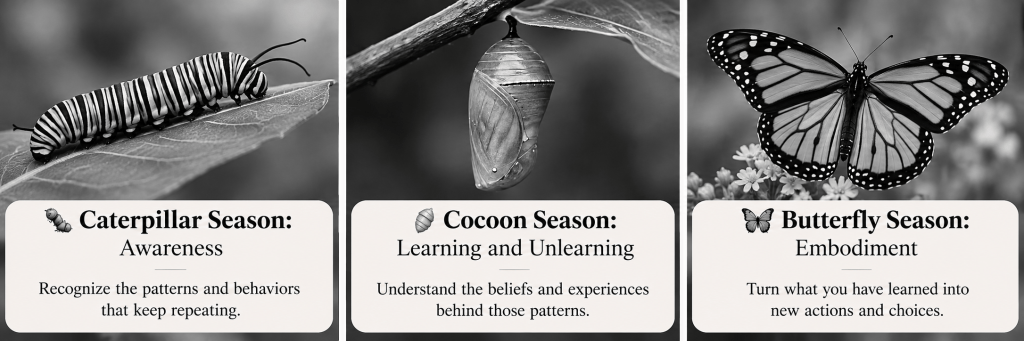
Aisha describes Caterpillar Season as the stage of becoming aware of the patterns in our lives. These might be repeated experiences, relationship difficulties, emotional reactions, or behaviors that seem to follow us from one situation to another.
Have you ever wondered why you keep experiencing the same problems, even when the people or circumstances are different?
Perhaps you repeatedly find yourself in relationships with similar dynamics. Maybe you keep overworking, struggle to say no, or find yourself trying to earn approval from other people.
Aisha shares how she once believed that certain people or business circumstances were responsible for her unhappiness. She changed her business arrangements and tried a different business model, but eventually noticed that some of the same patterns were appearing again.
She began to recognize that she was the common denominator in these repeated experiences and needed to examine her own behavior and beliefs.
This did not mean that every difficult situation was her fault. Instead, it gave her an opportunity to look at the parts of her experience that she could understand and change.
The lesson of Caterpillar Season is that awareness is the beginning of transformation.
You cannot change a pattern that you have not yet recognized.
🔍 Questions to Explore During Caterpillar Season
Take a moment to reflect on your own experiences:
🔄 What situations seem to keep repeating in my life?
💞 Do I notice similar patterns in my relationships?
🧠 How do I usually react when something makes me uncomfortable?
🤝 Am I constantly trying to please or impress other people?
🏆 Do I connect my worth to my achievements or productivity?
🔍 What patterns am I beginning to recognize?
You do not need to have all the answers immediately. The purpose of this stage is simply to become curious about your behavior instead of automatically repeating it.
🐚 2. Cocoon Season: Learning and Unlearning
Once we become aware of our patterns, the next step is understanding why they happen.
Aisha describes Cocoon Season as the process of learning and unlearning. It involves examining the beliefs, experiences, and personal rules that may influence the way we respond to situations.
During the interview, Aisha shares how she realized that she had connected her worth to achievement and performance. She believed that she needed to keep accomplishing things to feel valuable and receive recognition.
Even when she was successful, she struggled to feel fulfilled. She began exploring where those beliefs came from and how they influenced her decisions.
Aisha explains that sometimes our behaviors develop around rules we have learned throughout our lives.
For example:
📌 Situation: Someone is disappointed with me.
🧠 Underlying belief: I must keep everyone happy to be accepted.
🔄 Usual response: I ignore my own needs and agree to something I do not want.
💔 Result: I feel exhausted, frustrated, or disconnected from myself.
By examining this pattern, we can begin to understand why we respond the way we do.
Aisha also discusses people-pleasing, overgiving, perfectionism, withdrawing, and other behaviors she describes as forms of self-abandonment.
She explains that sometimes we try to avoid uncomfortable feelings instead of allowing ourselves to understand them.
Another topic she introduces is the projection loop. This involves examining whether our reactions to other people may be influenced by our own feelings or unresolved experiences. She also acknowledges that it can be difficult to distinguish projection from a genuine concern about someone else’s behavior.
The goal is not to dismiss our instincts or blame ourselves. It is to pause, examine our reactions, and consider different explanations.
The lesson of Cocoon Season is that understanding our patterns can help us recognize the beliefs that keep them going.
This stage may feel uncomfortable because becoming aware of something does not automatically give us the ability to change it. Sometimes, we need time to process what we have discovered.
🧠 Questions to Explore During Cocoon Season
🧠 What belief might be influencing my behavior?
🌱 Where might I have learned this way of responding?
😟 Am I trying to avoid a feeling that makes me uncomfortable?
💗 Do I feel that I must earn love, approval, or acceptance?
🤝 Am I ignoring my own needs to keep other people happy?
🦋 What would a different response look like?
Cocoon Season is about giving yourself the opportunity to understand what is happening beneath the surface.
You may discover things about yourself that are difficult to acknowledge. Be patient with yourself as you work through them.
🦋 3. Butterfly Season: Turning Awareness Into Action
Awareness and understanding are important, but transformation also requires action.
Aisha describes Butterfly Season as the stage of embodiment. This is where we begin applying what we have learned and practicing new ways of responding to life.
For example, if you have recognized that you constantly say yes because you are afraid of disappointing people, Butterfly Season may involve learning to say no respectfully.
If you have connected your self-worth to productivity, it may mean allowing yourself to rest without feeling that you must earn it.
If you have noticed that you withdraw whenever conflict arises, it may involve practicing more open and honest communication.
Aisha explains that taking new action can bring up fear because it challenges the familiar rules we have followed for a long time.
When we change our behavior, the people around us may also need time to adjust. Relationships that were built around familiar expectations can experience tension when one person begins setting boundaries or advocating for themselves.
During the interview, Aisha shares how she and her husband had to navigate their own individual growth and relationship changes. They both attended therapy, separately and together, as they worked through patterns and learned to understand each other better.
Adeline also highlights an important point about relationships: friction does not automatically mean a relationship is over. When people are willing to communicate and repair after difficult moments, those experiences can create opportunities for deeper connection.
The lesson of Butterfly Season is that meaningful change happens when we begin making different choices.
You do not have to change everything overnight. Small, consistent actions can help you move away from familiar patterns.
🌷 Questions to Explore During Butterfly Season
🎯 What is one behavior I would like to change?
🚧 What is one boundary I need to practice?
💬 How can I communicate my needs more honestly?
🦋 What would I do differently if I were not afraid of disappointing someone?
🔄 How can I respond differently the next time an old pattern appears?
🌱 What small action can I take today?
Transformation is not about becoming perfect. It is about becoming more aware of your choices and learning to respond in ways that better reflect your values and needs.
🧩 Why All Three Stages Matter
Aisha explains that the three stages work together. Each one plays a different role in the transformation process.
One important point Aisha makes is that becoming aware of a pattern does not mean we automatically know how to change it.
We may recognize that we are people-pleasing but still struggle to say no. We may understand that we connect our worth to achievement but still feel uncomfortable when we rest.
That is why the stages matter. They give us a way to move from recognizing a pattern, to understanding it, and eventually to practicing something different.
The process may take time, and we may need to revisit earlier stages as new situations arise.
📓 The Story Behind The Guided Transformation Journal
Aisha’s personal experience with self-discovery eventually inspired her to create The Guided Transformation Journal.
She explains that during therapy, she was asked to write paragraphs about her experiences. However, she found that visual frameworks and diagrams helped her understand herself more clearly.
Her background in law school also influenced the way she organized her thoughts. She used the framework of issue, rule, application, and conclusion to examine situations and identify patterns.
After sharing some of her exercises with a friend who was struggling, she realized that the framework might also be useful to other people.
She eventually created a guided journal and shared her work on TikTok. When a video about it gained attention, she began to see that the ideas were resonating with others.
During the interview, Adeline expresses how much she appreciates the journal’s structure and its invitation for readers to write their own names, experiences, reflections, and personal commitments.
Adeline also shares why this approach is meaningful to her as a brain injury survivor. She believes that writing down our own stories and experiences can make information more personal and meaningful.
She connects this idea with her own book, Love Love Brain, which also encourages readers to record their thoughts and experiences.
For people living with brain injury, written reflection may be useful for organizing thoughts or recording personal observations. However, everyone’s needs are different. Some may prefer diagrams, short prompts, voice notes, or conversations instead of lengthy writing exercises.
The important thing is finding a format that works for you.
🌻 Personal Transformation Does Not Have a Deadline
Near the end of the interview, Adeline asks Aisha how long it takes to complete The Guided Transformation Journal.
Aisha does not give a fixed number of hours. Instead, she encourages readers to move through the journal at their own pace.
She explains that some parts of the process can feel emotionally challenging, particularly when readers begin recognizing beliefs and patterns they have followed for years.
She acknowledges that someone may need to put the journal down for a while during Cocoon Season. However, she encourages readers to return to it and continue working through the process.
Adeline also shares her belief that the journal can be revisited during different decades and stages of life.
This is a meaningful idea because we do not remain the same person forever. Our priorities, relationships, experiences, and understanding of ourselves can change.
A question that mattered to us ten years ago may have a completely different answer today.
You do not have to rush your personal transformation. You can revisit your experiences, learn something new about yourself, and continue growing at your own pace.
💗 Love Love Brain Thoughts
Adeline’s conversation with Aisha Marshall reminds us that personal transformation is not simply about achieving more, becoming more successful, or meeting other people’s expectations.
It is also about understanding ourselves.
Aisha’s three-stage framework offers a simple way to think about that journey:
For people living with brain injury, personal transformation may involve adapting to changes in identity, abilities, relationships, and priorities. It may also mean discovering new ways to express ourselves and participate in life.
We do not all grow in the same way or on the same timeline. Some days we may feel ready to take action. Other days, we may need more time to understand what we are experiencing.
That is okay.
You do not have to rush from caterpillar to butterfly. Give yourself permission to experience each stage, learn from it, and keep moving forward. 💗
📖 Explore Aisha Marshall’s Work
If you would like to learn more about Aisha’s approach to self-discovery and personal transformation, explore her work and The Guided Transformation Journal.
📝 Love Love Brain Book Review:
The Guided Transformation Journal
🛒 Get the Journal on Amazon:
The Guided Transformation Journal
🌐 Butterfly SZN:
🌐 Aisha Marshall’s Website:
▶️ YouTube: @itsbutterflyszn
📸 Instagram: @itsbutterflyszn
🎵 TikTok: @itsbutterflyszn
Disclosure: Love Love Brain may earn a commission from qualifying purchases made through the Amazon link, at no additional cost to you.
🎥 Watch the Interview
Watch Adeline’s full conversation with Aisha Marshall as they explore the three stages of personal transformation, the inspiration behind The Guided Transformation Journal, and how awareness, reflection, and action can help us understand ourselves and make meaningful changes.
💬 We’d Love to Hear From You
Which stage of transformation are you experiencing right now?
🐛 Are you in Caterpillar Season, becoming aware of your patterns?
🐚 Are you in Cocoon Season, learning and unlearning?
🦋 Or are you in Butterfly Season, putting what you have learned into action?
Share your thoughts in the comments. Your experience may encourage someone else who is navigating their own journey of change. 💗
📱 Follow and Support Love Love Brain
If this message speaks to you, please support Love Love Brain by following us on social media. 💗
Stay connected for more stories, reflections, helpful information, and supportive content about brain injury, recovery, resilience, and everyday life.
Click the buttons below to follow and support us on social media:
Note: Every brain injury is different. This content is for education and support, not medical advice. The journal and ideas discussed are intended for personal reflection and are not a substitute for therapy, mental health care, or other professional support.



Do you Love Love YOUR Brain?