
What if our minds and brains are not completely fixed?
What if our repeated experiences can influence the way our brains function?
Buddha’s Brain by Rick Hanson, PhD, with Richard Mendius, MD combines neuroscience with insights from Buddhist contemplative traditions. The book explores happiness, love, wisdom, mindfulness, and the ways repeated mental experiences can influence the brain.
The book’s central idea can be especially interesting for people living with brain injury because recovery often involves learning new patterns.
🧠 The Brain Can Change
Neuroplasticity has changed the way we think about the brain.
The brain isn’t simply a static organ.
It responds to experience.
It learns.
It adapts.
It creates and strengthens patterns.
That doesn’t mean every injury can simply be overcome through positive thinking.
It doesn’t.
But it does mean the brain has remarkable capacity for adaptation.
🌱 What We Practice Matters
What do we practice every day?
Worry?
Fear?
Anger?
Self-criticism?
Or can we also practice:
Calm.
Gratitude.
Compassion.
Patience.
Connection.
The book explores ways mindfulness and repeated positive experiences may help strengthen beneficial mental states.
💭 Learning to Notice the Good
Sometimes difficult experiences become very powerful.
One negative comment can stay with us all day.
One frightening symptom can dominate our attention.
One mistake can feel bigger than everything we did well.
Learning to notice positive experiences doesn’t mean ignoring the negative.
It means allowing the good moments to matter too.
🧘 Mindfulness and Recovery
Mindfulness can mean simply noticing what is happening right now.
Your breathing.
Your surroundings.
Your thoughts.
Your body.
Your emotions.
You don’t have to make everything disappear.
You can simply notice.
❤️ Compassion Toward Yourself
Brain injury can create an enormous amount of self-criticism.
Why can’t I do this?
Why am I so tired?
Why am I different?
What if we asked instead:
What would I say to someone I love who was going through this?
Then perhaps we can say the same thing to ourselves.
🦋 Healing Is Also an Inner Journey
Recovery involves the brain and body.
But it can also involve identity.
Emotions.
Relationships.
Meaning.
Self-worth.
Mindfulness can provide one way to explore these inner experiences.
💗 Love Love Brain Thoughts
Your brain has been through something.
You don’t have to be angry with it for not working exactly as it once did.
You can learn it.
Support it.
Respect it.
Listen to it.
And care for yourself along the way.
Healing can include learning how to be kinder to the brain that is carrying you through it.
📖 Where to Find the Book
Buddha’s Brain by Rick Hanson, PhD, with Richard Mendius, MD is available through major book retailers. New Harbinger currently publishes a 15th-anniversary edition.
🛒 Get the Book on Amazon
Love Love Brain may earn a small commission from qualifying purchases made through this link. This does not affect the price you pay.
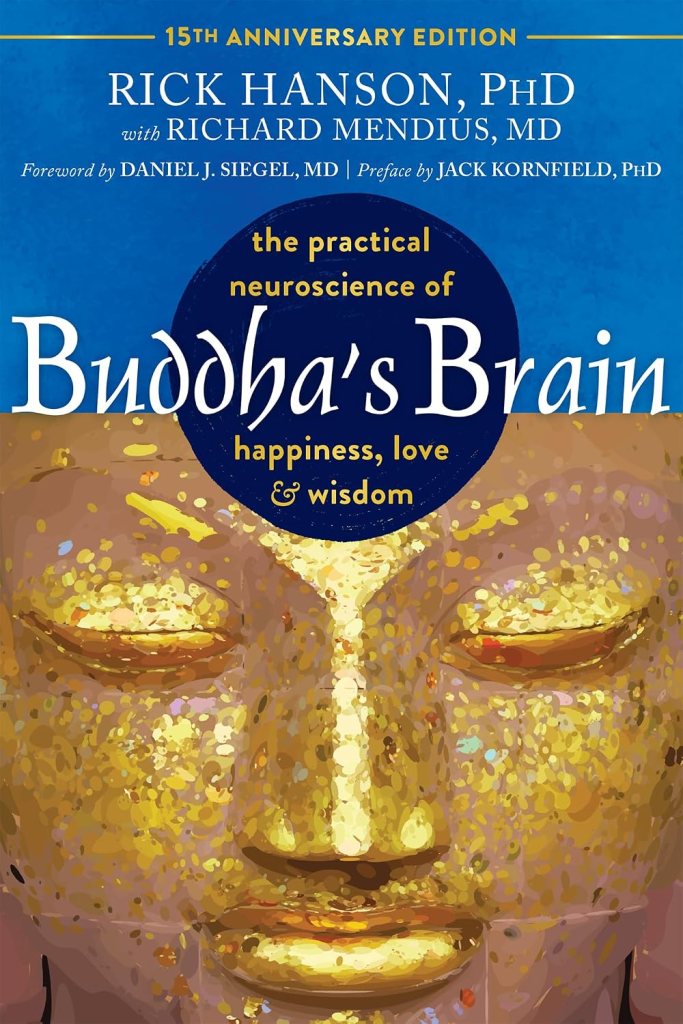
Book cover belongs to the publisher and is displayed for identification and review purposes.
Note: This book review is for educational and reflective purposes only and is not medical advice.


Do you Love Love YOUR Brain?