
What happens inside the brain when fear takes over?
Why can anxiety appear even when we know intellectually that we’re safe?
And why can some worries be so difficult to turn off?
Rewire Your Anxious Brain by Catherine M. Pittman, PhD, and Elizabeth M. Karle explores anxiety through the lens of neuroscience.
The book explains the different roles of the amygdala and cortex in anxiety and offers strategies for working with these different pathways. The second edition was published in 2025 and was fully revised and updated.
🧠 Two Ways Anxiety Can Show Up
The book distinguishes between fear responses associated with the amygdala and worry associated with the cortex.
The amygdala can generate a rapid fear response, sometimes before we consciously understand why we’re afraid.
The cortex is associated with conscious worry, rumination, and imagining things that might happen.
Understanding these different pathways can make anxiety feel less mysterious.
😰 Fear Can Feel Real
After brain injury, anxiety can become especially complicated.
You may worry about:
Driving.
Returning to work.
Being around crowds.
Forgetting something.
Having another accident.
Making mistakes.
Being misunderstood.
When the brain has experienced trauma, it makes sense that the nervous system may become more cautious.
That doesn’t mean you are weak.
It means your brain is trying to protect you.
💭 When Worry Takes Over
Sometimes anxiety isn’t an immediate fear.
It’s a thought loop.
“What if?”
“What if I can’t do it?”
“What if something goes wrong?”
“What if they think I’m strange?”
“What if I never recover?”
The more we think, the more real the worry can feel.
The book provides strategies designed to help readers understand and manage these patterns.
🌱 Understanding Can Be Empowering
One of the most useful things about understanding anxiety is realizing that it isn’t simply a character flaw.
There are biological processes involved.
There are learned responses.
There are thought patterns.
There are behaviors that can reinforce anxiety.
Understanding these mechanisms can give you more choices.
Instead of:
“What’s wrong with me?”
you can begin asking:
“What is my brain doing right now?”
🧘 Learning New Responses
The goal isn’t necessarily to eliminate every anxious feeling.
Fear is a normal human response.
The goal can be learning how to respond differently.
Pause.
Notice.
Breathe.
Check the evidence.
Take a manageable step.
And gradually teach your brain that not every situation requires the same level of alarm.
❤️ Especially Meaningful for Brain Injury
One particularly relevant connection is that Dr. Pittman specializes clinically in brain injuries and anxiety disorders, according to the publisher’s author information.
That makes this book particularly interesting for readers in the brain injury community who are also dealing with anxiety.
💗 Love Love Brain Thoughts
Anxiety can make the future feel like a threat.
But the future hasn’t happened yet.
You don’t have to answer every “what if.”
You don’t have to eliminate every fear before moving forward.
Sometimes courage simply means:
“I’m scared, and I’m going to take one small step anyway.”
Your brain may be trying to protect you.
Learning to understand that protection can be the beginning of learning when you need to listen to it and when you can gently reassure it:
“We’re okay. We can take this slowly.”
💬 We’d Love to Hear From You
What situations make your brain feel most anxious?
What helps you calm your nervous system?
Have you learned to recognize the difference between fear and worry?
Share your experience in the comments.
📖 Where to Find the Book
The updated second edition of Rewire Your Anxious Brain was published by New Harbinger Publications in December 2025 and is available in paperback and ebook formats.
🛒 Get the Book on Amazon
Love Love Brain may earn a small commission from qualifying purchases made through this link. This does not affect the price you pay.
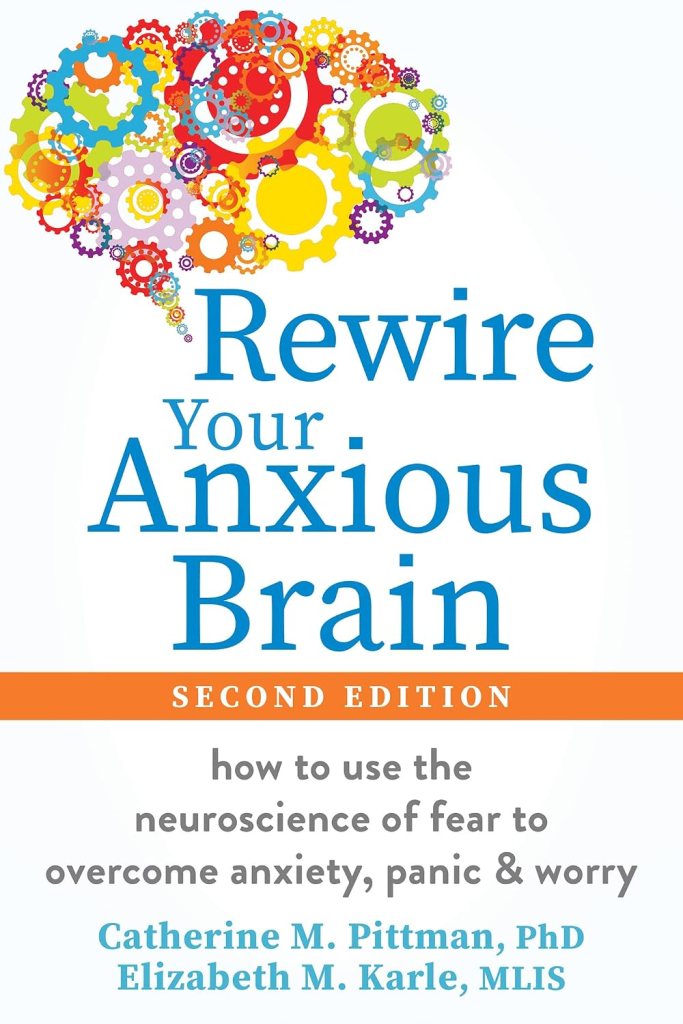
Book cover belongs to the publisher and is displayed for identification and review purposes.
Note: This review is for educational purposes only. It is not a substitute for professional assessment or treatment for anxiety, panic, or brain injury.


Do you Love Love YOUR Brain?