
Sometimes the hardest part of having a busy mind isn’t the amount of thoughts you have.
It’s trying to keep up with all of them.
You may start one task and suddenly remember another.
You may lose track of what you were doing.
You may struggle to stay focused even when something is important to you.
You may become frustrated because you know what you want to accomplish, but getting there feels much harder than it should.
Scattered Minds by Lenard Adler and Mari Florence explores adult ADHD and the challenges that can come with attention, organization, focus, and everyday functioning. Dr. Adler, who directed the Adult ADHD Program at New York University, presents information about recognizing ADHD, obtaining an accurate diagnosis, treatment options, and practical coping strategies.
Although the book focuses on ADHD, some of its discussions around attention, organization, and coping may feel familiar to people living with cognitive challenges after brain injury.
🧠 When Your Mind Feels Scattered
There are days when your brain seems to have a hundred tabs open at once.
You want to concentrate.
You really do.
But your attention keeps moving.
A sound catches your attention.
A thought interrupts another thought.
A task reminds you of something else.
Before you know it, you’ve moved from one thing to another.
For someone already dealing with cognitive fatigue or changes in attention after brain injury, this can feel especially frustrating.
💭 It Isn’t Always About Trying Harder
When something looks easy for everyone else, we can start blaming ourselves.
“Why can’t I just focus?”
“Why am I so disorganized?”
“Why do I keep forgetting things?”
But difficulty with attention isn’t necessarily a matter of not caring enough.
Sometimes the brain needs different strategies.
Instead of demanding that yourself simply “try harder,” it can be more helpful to ask:
“What would make this easier for my brain?”
📝 Finding Strategies That Work
One of the practical messages that can be taken from a book like Scattered Minds is the importance of finding tools that support the way your brain functions.
That might mean:
📝 Writing things down
⏰ Using reminders
📋 Making checklists
🧩 Breaking large tasks into smaller steps
🔇 Reducing distractions
⏸️ Taking regular breaks
These aren’t signs that you aren’t capable.
They are tools that can make everyday life more manageable.
🧠 Understanding Your Brain Can Reduce Shame
When we don’t understand why something is difficult, we can easily turn the difficulty into a judgment about ourselves.
Instead of:
“I’m lazy.”
we might begin thinking:
“I’m having trouble with attention right now.”
Instead of:
“I can’t do anything right.”
we might ask:
“What strategy could help me complete this?”
That change in language can make a difference.
🌱 Working With Your Brain
After brain injury, many survivors discover that the strategies that worked before the injury don’t always work anymore.
You may need more structure.
You may need more time.
You may need quiet.
You may need reminders.
You may need to focus on one thing at a time.
Learning these new strategies isn’t giving up.
It is learning how to work with the brain you have today.
❤️ Progress Can Look Different
Sometimes progress isn’t finishing everything on your list.
Sometimes progress is completing one important task.
Sometimes it is recognizing that you’re becoming overwhelmed and taking a break before you reach your limit.
Sometimes it is remembering to use the strategy that helps you.
Small changes count.
🌻 You Don’t Have to Fight Your Brain
Your brain isn’t your enemy.
It may have challenges.
It may need support.
It may work differently than someone else’s.
But you can learn to understand it.
You can learn its patterns.
You can discover what helps.
And you can build routines that support you rather than constantly fighting against yourself.
💗 Love Love Brain Thoughts
Scattered Minds reminds us that understanding how our minds work can be an important step toward greater self-compassion.
For anyone living with brain injury, attention and cognitive challenges can sometimes create a painful cycle of frustration and self-blame.
But needing strategies doesn’t make you less capable.
Using reminders doesn’t make you less intelligent.
Taking breaks doesn’t make you lazy.
Asking for help doesn’t make you weak.
Sometimes the smartest thing we can do is stop fighting ourselves and start supporting ourselves.
Your brain may work differently.
That’s okay.
Learn its language.
Find what helps.
Give yourself time.
And remember that you are much more than the things your brain finds difficult.
💬 We’d Love to Hear From You
Do you struggle with focus, organization, or a busy mind?
What strategies help you stay on track?
What is one tool that has made everyday life a little easier?
Share your experience in the comments.
Your story may help another survivor feel less alone.
📖 Where to Find the Book
Scattered Minds was published by Tarcher/Penguin. The 2007 paperback edition is listed at 208 pages and includes information about adult ADHD, diagnosis, treatment options, and coping strategies.
🛍️ Get the Book on Amazon
Love Love Brain may earn a small commission from qualifying purchases made through this link. This does not affect the price you pay.
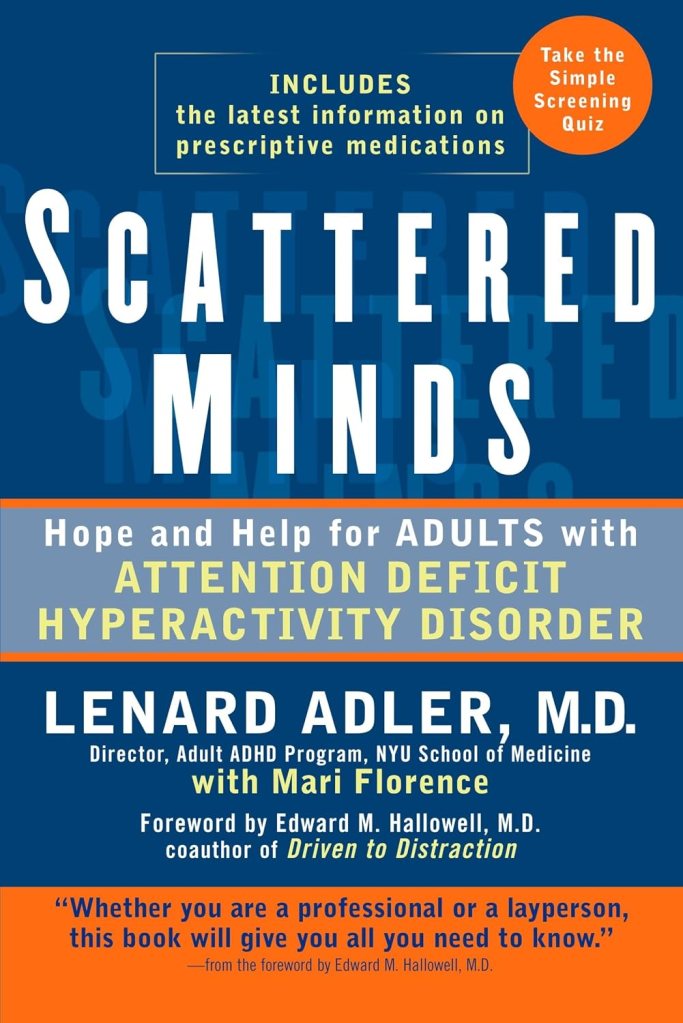
Book cover belongs to the publisher and is displayed for identification and review purposes.
Note: This book review is for educational and reflective purposes only and is not medical advice.


Do you Love Love YOUR Brain?