
What if you could learn to recognize the thoughts that make difficult moments even harder?
What if you could practice responding to those thoughts differently?
The CBT Workbook for Mental Health by Simon Rego, PsyD, and Sarah Fader introduces readers to practical exercises based on Cognitive Behavioral Therapy (CBT).
The workbook focuses on understanding the relationship between thoughts, emotions, and behaviors and provides exercises designed to help readers build coping skills and improve emotional wellbeing.
🧠 Thoughts Can Affect How We Feel
Imagine thinking:
“I’m going to fail.”
That thought may create anxiety.
Anxiety may lead to avoidance.
Avoidance can make the task feel even more frightening.
CBT helps us examine these cycles.
Instead of automatically accepting the thought, we can ask:
“Is this thought accurate?”
“What evidence do I have?”
“Is there another way to look at this?”
🐜 Recognizing Automatic Negative Thoughts
This connects closely with the idea of ANTs, or automatic negative thoughts.
Thoughts such as:
“I’m useless.”
“Nobody understands me.”
“I’ll never improve.”
“Everything is going wrong.”
can feel like facts.
CBT teaches us to examine them.
Not every thought deserves to be believed.
🌱 Practical Exercises
One of the strengths of this workbook is its practical format.
The exercises are designed to take approximately 10 to 30 minutes, making them relatively easy to fit into everyday life.
The workbook covers topics including:
❤️ Self-esteem and self-acceptance
🤝 Relationships and communication
😰 Anxiety
😡 Anger
🌪️ Stress
💔 Guilt and shame
🍽️ Cravings
These exercises can be used for reflection and skill-building.
💭 Changing the Inner Critic
Many people have an inner voice that constantly points out what they’re doing wrong.
After brain injury, that voice can become especially harsh.
“You should be further along.”
“You used to be able to do this.”
“Why can’t you remember?”
Instead of automatically believing that voice, CBT encourages us to examine it.
Would you speak to a friend the way you’re speaking to yourself?
If not, perhaps it’s time to change the conversation.
🧠 Especially Relevant to Brain Injury
Brain injury recovery can involve frustration, anxiety, guilt, and changes in self-esteem.
A workbook that teaches readers to identify thought patterns and practice alternative responses can provide another tool for emotional wellbeing.
It doesn’t replace therapy.
But it can help people become more active participants in understanding their own thought patterns.
❤️ Small Exercises Can Create Awareness
You don’t have to complete every exercise at once.
Choose one.
Write.
Reflect.
Notice what comes up.
Try again tomorrow.
The goal isn’t perfection.
It’s practice.
💗 Love Love Brain Thoughts
The CBT Workbook for Mental Health reminds us that our thoughts can influence our emotions and behaviors, but we can learn to examine those thoughts rather than automatically accepting them.
For a brain injury survivor, this can be a powerful distinction.
“I am struggling” is different from “I am a failure.”
“This is difficult” is different from “I can’t do anything.”
“I need help” is different from “I am a burden.”
Changing the words doesn’t erase the difficulty.
But sometimes it changes the way we carry it.
💬 We’d Love to Hear From You
What negative thought do you find yourself repeating?
Have you learned a healthier way to respond to it?
What helps you quiet your inner critic?
Share your experience in the comments.
📖 Where to Find the Book
The CBT Workbook for Mental Health was published in 2021 by Callisto/Sourcebooks and contains practical exercises covering areas such as self-esteem, relationships, anxiety, stress, anger, guilt, shame, and cravings.
🛒 Get the Book on Amazon
Love Love Brain may earn a small commission from qualifying purchases made through this link. This does not affect the price you pay.
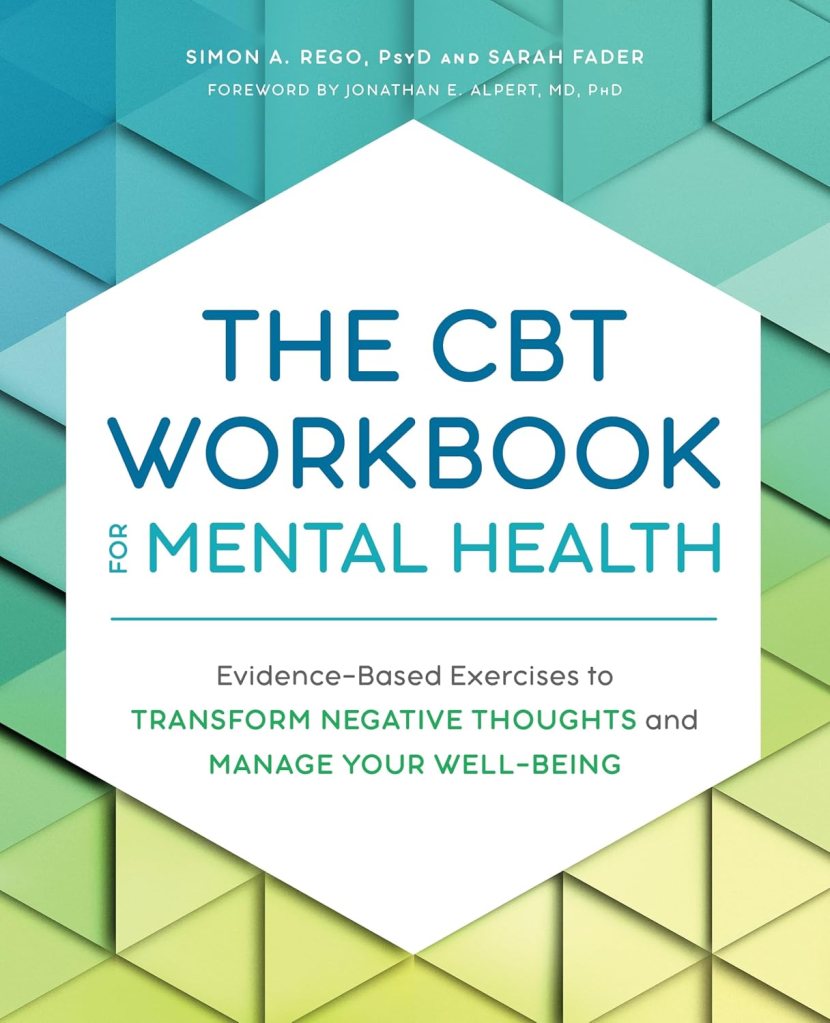
Book cover belongs to the publisher and is displayed for identification and review purposes.
Note: This workbook is for educational purposes and should not replace individualized mental health treatment or professional guidance.


Do you Love Love YOUR Brain?