
Healing after a brain injury is not always a straight line.
Some days, I feel like I am making progress.
Other days, something small can happen and suddenly I find myself overwhelmed by emotions, thoughts, memories, or physical symptoms that seem much bigger than the situation in front of me.
One of the coaches who has been helping me through my healing journey is Becka Bristow.
Working with Becka has helped me look at some of these experiences differently. Instead of seeing difficult moments as failures, I am learning to notice the patterns that can keep me stuck.
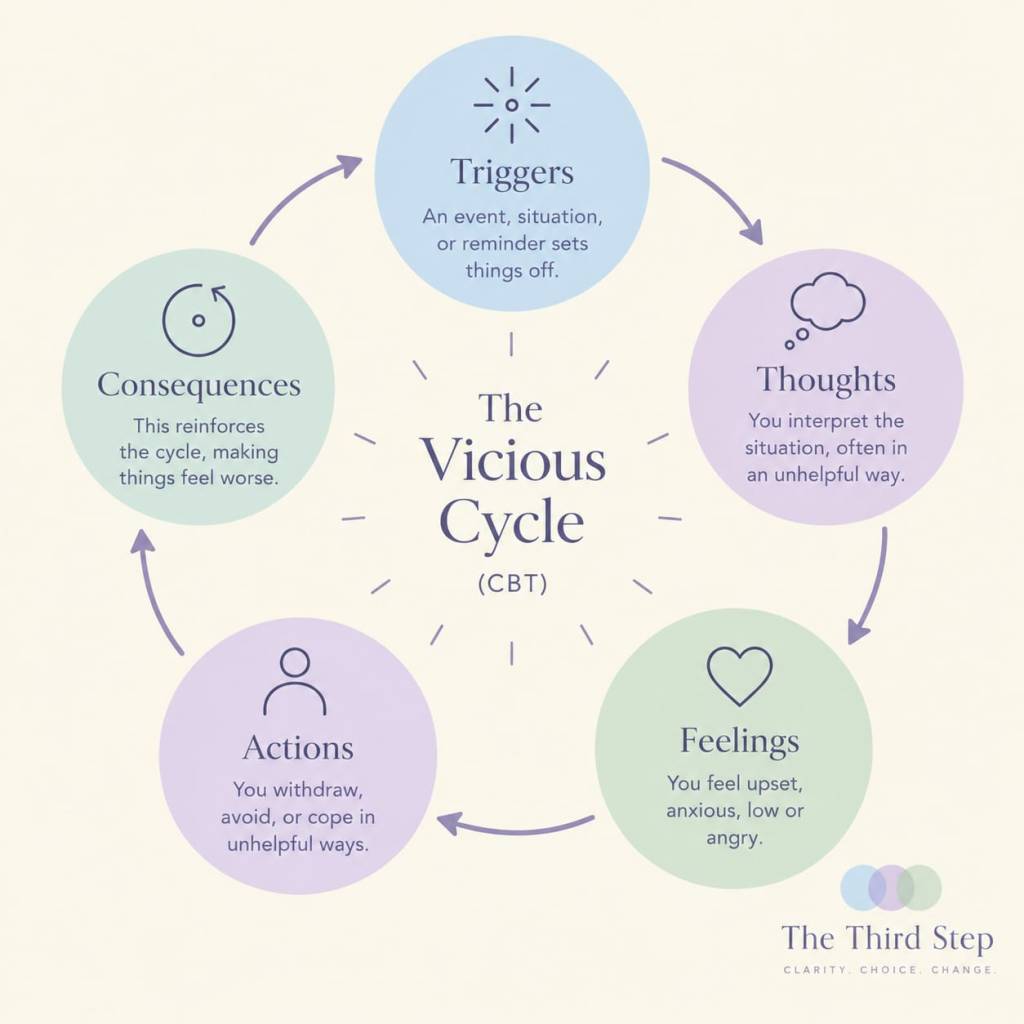
One of those patterns is what this illustration calls The Vicious Cycle (CBT).
💗 The Cycle Can Start With a Trigger
The illustration begins with Triggers.
A trigger can be an event, situation, or reminder that sets things off.
For someone living with the effects of brain injury, a trigger does not always have to seem big to someone else.
It might be a conversation.
A memory.
A change in plans.
A difficult interaction.
Feeling misunderstood.
Being overwhelmed.
Or simply having a day when my brain and body are already working harder than usual.
The important thing I am learning is that the trigger is only one part of the cycle.
💭 Then Come Our Thoughts
After a trigger, we interpret what happened.
The illustration describes thoughts as the way we interpret a situation, sometimes in an unhelpful way.
This part has been important for me.
Because a thought can feel like a fact.
If I think, “I can’t handle this,” my brain may immediately begin responding as though I truly cannot.
If I think, “Nobody understands me,” I may begin withdrawing.
If I think, “I’m failing again,” I may feel defeated before I have even given myself a chance.
Brain injury can already make thinking, processing, communicating, and managing emotions more challenging.
That means noticing our thoughts can be an important part of understanding what is happening inside us.
💗 Thoughts Affect Feelings
The next part of the cycle is Feelings.
The illustration includes feelings such as being upset, anxious, low, or angry.
A thought can change how we feel.
And when we are already tired, overwhelmed, or emotionally vulnerable, those feelings can become intense.
I have learned that I do not always have control over the first feeling that arrives.
But I can begin learning to notice it.
Instead of immediately judging myself for feeling anxious, angry, sad, or overwhelmed, I can pause and ask:
What happened?
What am I thinking about what happened?
What am I feeling right now?
That pause can create a little space between the experience and my response.
🧠 Feelings Can Influence Our Actions
The next step is Actions.
The illustration describes actions such as withdrawing, avoiding, or coping in unhelpful ways.
This is another place where the cycle can become powerful.
When I feel overwhelmed, I may want to pull away.
When I feel anxious, I may avoid something.
When I feel hurt, I may shut down.
And sometimes those actions provide temporary relief.
But temporary relief does not always solve the underlying problem.
Sometimes avoidance can make the next situation feel even harder.
Sometimes withdrawing can leave me feeling more isolated.
And sometimes a coping strategy that helped me survive one situation may not be the strategy I need today.
🔄 Then Come the Consequences
The final part of the illustration is Consequences.
The consequence can reinforce the cycle and make things feel worse.
That is what makes it a vicious cycle.
A trigger leads to thoughts.
Thoughts influence feelings.
Feelings influence actions.
Actions have consequences.
And those consequences can make future triggers feel even more difficult.
Then the cycle starts again.
🌱 Becka Helps Me See the Pattern
This is one of the reasons having support has been so meaningful to me.
Becka does not simply tell me what to do.
Working with a coach can give me space to slow down, look at what is happening, and become more aware of the patterns underneath my reactions.
For me, healing is not about becoming someone who never gets triggered.
It is not about never feeling anxious.
It is not about never getting angry, overwhelmed, sad, or exhausted.
And it certainly does not mean that I should blame myself when those feelings happen.
Healing is about learning to recognize what is happening and finding healthier ways to respond.
Sometimes the first step is simply noticing:
I’m in the cycle.
That awareness matters.
💗 You Don’t Have to Change Everything at Once
One thing I appreciate about this kind of framework is that I don’t have to fix every part of the cycle at the same time.
I can start with one small pause.
Maybe I notice a trigger.
Maybe I question a thought.
Maybe I give myself permission to feel something without immediately reacting.
Maybe I choose a different action.
Maybe I ask for help.
Maybe I take a break.
Maybe I communicate what I need instead of disappearing.
Small changes can create a different direction.
And when you are healing from a brain injury, small changes can be meaningful changes.
🤍 Healing Is Not About Blaming Yourself
This is especially important to me.
Learning about a cycle should never become another reason to blame ourselves.
Brain injury can affect the way we process information, regulate emotions, communicate, manage stress, and respond to our environment.
We are human beings doing our best with the brains and bodies we have today.
The purpose of recognizing a cycle is not to say:
“This is my fault.”
It is to say:
“Now I can see what is happening.”
There is a big difference.
Awareness can create choice.
And choice can create change.
💗 Why Support Matters
I am grateful for the people who walk alongside me during this healing journey.
Becka Bristow is one of the coaches helping me.
Having someone who can listen, ask questions, help me notice patterns, and encourage me to look at situations from another perspective has become part of my healing process.
Sometimes we need someone outside ourselves to help us see what we cannot see when we are in the middle of it.
That does not make us weak.
It means we are willing to receive support.
And I am learning that receiving support is part of healing, too.
🌱 Breaking the Cycle Can Begin With One Moment
Maybe you recognize yourself in this illustration.
Maybe you have experienced the cycle:
Trigger → Thoughts → Feelings → Actions → Consequences → Trigger
If you do, please remember that recognizing the cycle does not mean you are broken.
It means you are becoming more aware.
And awareness can be the beginning of something different.
You may not be able to control every trigger.
You may not be able to stop every difficult thought from appearing.
You may not be able to choose every feeling that comes up.
But with the right support, patience, and practice, you can begin exploring different ways of responding.
That is part of my healing journey.
And I am grateful that Becka is one of the people helping me walk through it.
💗 A Little Reminder From Love Love Brain
You are not your thoughts.
You are not your worst day.
You are not your reaction to a trigger.
You are a person healing, learning, adapting, and growing.
Sometimes healing begins simply by noticing the cycle.
And sometimes, the next step is asking someone to walk beside you.
You do not have to heal alone.


Do you Love Love YOUR Brain?