
Suffering is something most of us want to escape.
When we are hurting, overwhelmed, grieving, angry, afraid, or struggling with something we cannot change, our first instinct may be to ask:
“How do I make this stop?”
But what if there is another question we can ask?
“What can this suffering teach me?”
That question stayed with me after listening to a powerful conversation on Ten Percent Happier with Dan Harris, featuring meditation teacher Joseph Goldstein.
In the episode, Goldstein talks about a phrase he uses in teaching:
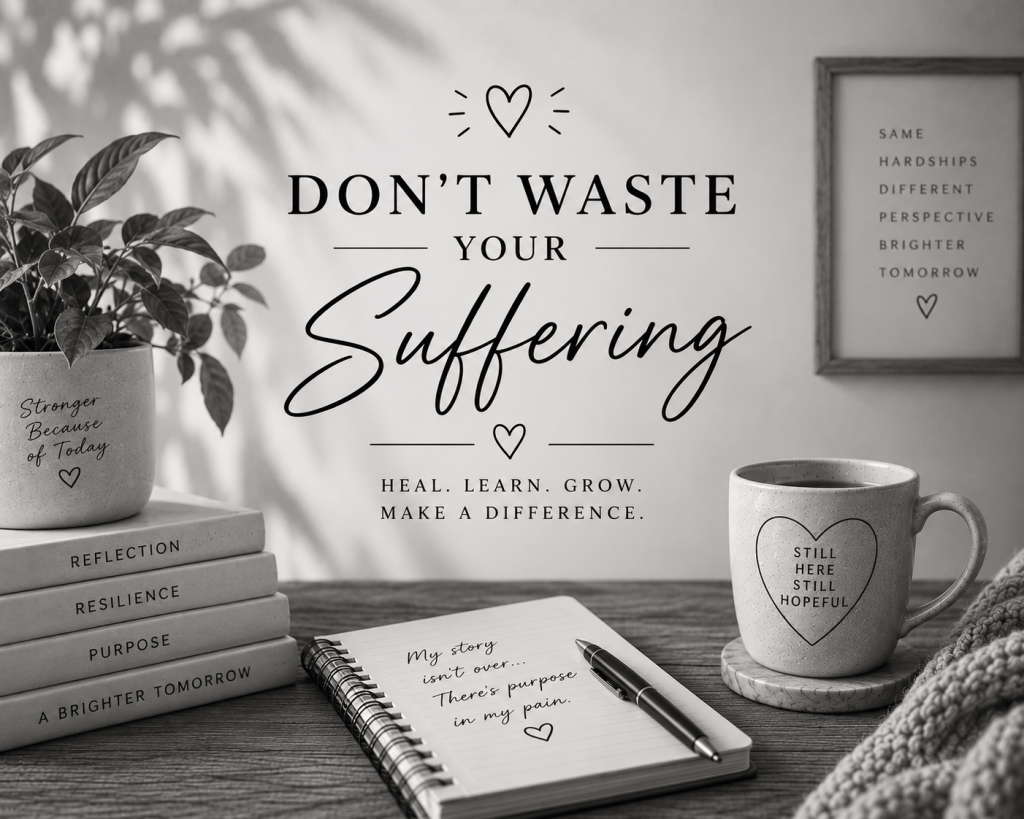
“Don’t waste your suffering.”
For someone living with the effects of brain injury, this idea can open up a very different way of looking at difficult experiences.
💗 Suffering Is Not Something We Have to Waste
When we are suffering, it is easy to become completely absorbed in it.
We may think about what happened over and over.
We may blame ourselves.
We may blame other people.
We may blame our circumstances.
We may ask:
“Why me?”
Those questions are understandable.
Brain injury can change so much about a person’s life. There can be physical symptoms, cognitive changes, emotional challenges, relationship difficulties, loss of independence, changes in identity, and uncertainty about the future.
There is real suffering in that.
We should never minimize it.
But Goldstein offers another possibility: instead of becoming completely lost in suffering, we can become curious about it.
What is happening inside my mind right now?
What am I telling myself about this experience?
What am I holding onto?
What am I afraid of?
What am I expecting?
What might I learn from this moment?
That is a very different relationship with suffering.
🧠 The Experience and Our Relationship to It
One of the ideas discussed in the conversation is that suffering is not simply about what happens to us.
It is also about how we relate to what happens.
That distinction really resonates with me.
I cannot always control what happens to my brain or my body.
I cannot control every symptom.
I cannot control how other people respond to me.
I cannot undo my injury.
I cannot make every difficult memory disappear.
But I can begin to notice my relationship with what is happening.
Sometimes the suffering comes from the original experience.
Sometimes another layer gets added by the thoughts surrounding it.
“This shouldn’t be happening.”
“I’m never going to get better.”
“Nobody understands me.”
“I should be able to do more.”
“I’m not who I used to be.”
Those thoughts can become another source of pain.
Learning to notice them does not mean pretending the original problem isn’t real.
It means becoming curious about what happens next.
🌱 What If a Trigger Became an Invitation to Investigate?
This connects beautifully with the work I have been doing in my own healing journey.
Recently, I shared the vicious cycle of CBT:
Trigger → Thoughts → Feelings → Actions → Consequences → Trigger
A trigger happens.
We interpret it.
That interpretation affects how we feel.
Our feelings influence what we do.
Our actions create consequences.
And those consequences can reinforce the original cycle.
Learning to recognize this pattern gives me something incredibly valuable:
a moment of awareness.
Instead of immediately reacting, I can sometimes pause.
I can ask:
“What’s happening inside me right now?”
That question can be powerful.
💗 Pain Can Become Information
I don’t believe suffering is something we should romanticize.
There are experiences that are simply painful.
There are things that should never have happened.
There are losses that deserve to be grieved.
And there are moments when we need professional support, medical care, rest, or simply someone to sit beside us.
“Don’t waste your suffering” does not mean:
Be grateful that you suffered.
It does not mean:
Your suffering happened for a reason.
And it does not mean:
You should be able to think your way out of pain.
For me, the message is much gentler:
If I am already experiencing something difficult, perhaps I can learn something from what is happening inside me.
My suffering might show me where I need support.
It might reveal a fear.
It might show me a pattern.
It might teach me where I need boundaries.
It might remind me to slow down.
It might teach me to ask for help.
It might help me understand myself differently.
🌻 Curiosity Can Change the Conversation
Imagine replacing:
“Why is this happening to me?”
with:
“What is happening inside me right now?”
Instead of:
“I can’t handle this.”
Perhaps:
“What part of this feels hardest?”
Instead of:
“I need this feeling to go away.”
Perhaps:
“Can I sit with this feeling long enough to understand it?”
Those questions do not magically eliminate suffering.
But they can create spaciousness.
And that spaciousness can give us room to respond rather than simply react.
Goldstein describes this as something that takes practice.
I think that is important.
We are not expected to master this overnight.
🧘 Mindfulness Is Not About Never Suffering
One of the things I appreciated about this conversation is that mindfulness is not presented as simply being happy or peaceful all the time.
It is about learning to recognize what is happening without immediately being consumed by it.
Fear can be there.
Anger can be there.
Sadness can be there.
Pain can be there.
A difficult thought can be there.
And we can begin learning to observe our experience without automatically becoming our experience.
That distinction can be especially meaningful after brain injury.
Because healing does not necessarily mean returning to the person we were before.
Sometimes healing means learning a new relationship with the person we are becoming.
💗 A Podcast Worth Listening To
If these ideas speak to you, I highly recommend listening to Ten Percent Happier with Dan Harris, particularly Episode 598, “Joseph Goldstein On: How Not To Try Too Hard in Meditation, Why You Shouldn’t ‘Waste Your Suffering,’ and the Value Of Seeing How Ridiculous You Are.” The episode explores suffering, mindfulness, the Eightfold Path, meditation, comparison, emotional states, and how we relate to our own minds.
Watch the YouTube Short that inspired this post:
🎙️ Meet the Speakers
Dan Harris is the host of Ten Percent Happier and has built the podcast around conversations about meditation, mindfulness, happiness, mental health, and living with greater awareness.
Joseph Goldstein is a highly respected meditation teacher and a co-founder of the Insight Meditation Society. In this conversation, he brings decades of meditation practice and Buddhist teaching to everyday questions about suffering, mindfulness, and how our minds work. The episode also explores the Eightfold Path and how its teachings can be applied beyond formal meditation.
What I especially appreciate is that the conversation does not make mindfulness sound like another thing we have to be perfect at.
It is a practice.
We notice.
We investigate.
We learn.
We begin again.
🌻 What This Means to Me
As I continue my own healing journey, I am learning that I don’t have to love what happened to me in order to learn from it.
I don’t have to call my brain injury a blessing.
I don’t have to pretend that difficult days aren’t difficult.
I don’t have to be positive every minute.
I can acknowledge the pain.
I can grieve what I have lost.
I can ask for help.
And I can still become curious about what my experience is teaching me.
Maybe that is what “don’t waste your suffering” means for me.
Not turning suffering into something beautiful.
Not pretending it doesn’t hurt.
But refusing to let the pain be the only thing I take from it.
I can learn from it.
I can grow through it.
I can understand myself more deeply because of it.
And sometimes, healing begins with something as simple as asking:
“What is my suffering trying to show me?”
💗 A Love Love Brain Reminder
You do not have to figure everything out today.
You do not have to turn your pain into a lesson immediately.
Sometimes the first step is simply making enough space to notice what you are feeling.
And if you need help doing that, asking for support is not weakness. It is part of healing.
Don’t waste your suffering.
But also, don’t suffer alone.


Do you Love Love YOUR Brain?