
After a brain injury, it can be easy to feel responsible for everything.
Your recovery.
Your symptoms.
Other people’s feelings.
Other people’s reactions.
Things that happened to you.
Things you wish you had done differently.
And sometimes, you may even feel responsible for things that were never yours to carry in the first place.
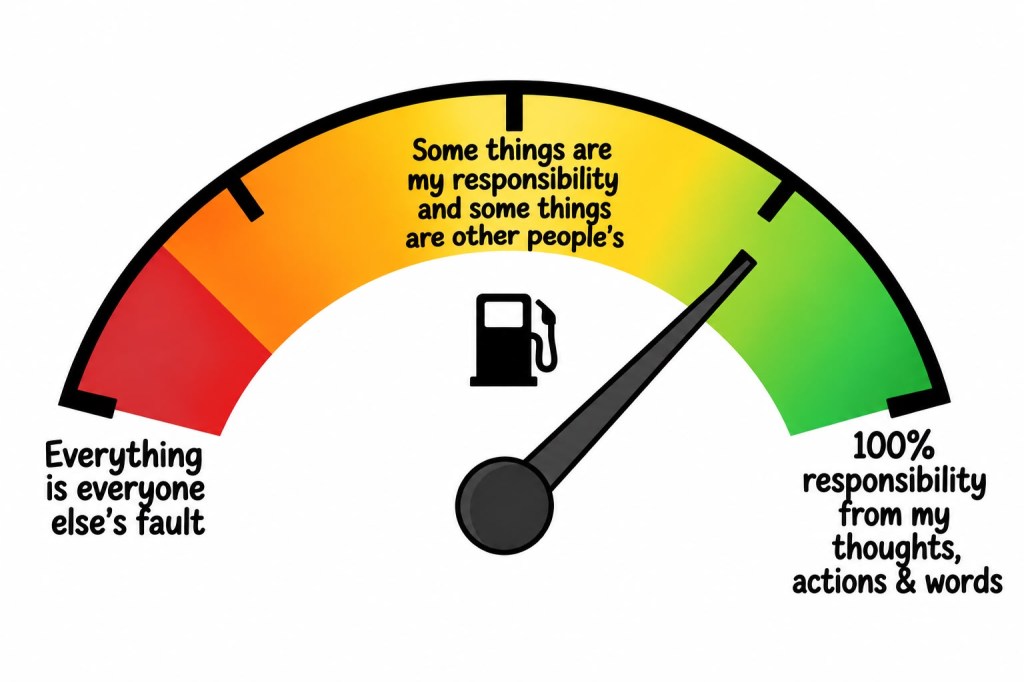
The illustration above offers a simple but powerful reminder:
Some things are our responsibility, and some things belong to other people.
🧠 The Responsibility Gauge
Imagine your sense of responsibility as a gauge.
At one end is:
“Everything is everyone else’s fault.”
At the other end is:
“Everything is my responsibility.”
Neither extreme gives us much freedom.
The healthier place is somewhere in the middle.
I am responsible for my thoughts, my words, and my actions.
But I am not responsible for controlling everything around me.
💗 Brain Injury Can Make This Harder
Brain injury can change how we process emotions, stress, relationships, and everyday situations.
You may replay conversations in your head.
You may worry about how someone interpreted what you said.
You may feel guilty when you need help.
You may blame yourself when something goes wrong.
You may also become frustrated with other people because you feel they don’t understand what you’re experiencing.
These feelings are real.
But feeling responsible for everything does not mean that everything is actually your responsibility.
🎒 You Don’t Have to Carry Everyone’s Backpack
Think about carrying a backpack.
You already have your own recovery to manage.
Your symptoms.
Your appointments.
Your energy.
Your emotions.
Your relationships.
Your daily responsibilities.
Now imagine putting everyone else’s problems into that same backpack.
Their reactions.
Their choices.
Their moods.
Their expectations.
Their mistakes.
Their opinions.
Pretty soon, the backpack becomes impossible to carry.
You are allowed to put down what does not belong to you.
🌱 What Is Actually Mine?
A helpful question is:
“What part of this situation is mine?”
Maybe it is your response.
Maybe it is asking for help.
Maybe it is communicating a boundary.
Maybe it is apologizing when you have genuinely hurt someone.
Maybe it is taking responsibility for something you said or did.
Those things are within your control.
But you cannot control another person’s response.
You cannot make someone understand your brain injury.
You cannot make someone be patient.
You cannot control someone’s mood.
You cannot change someone else’s choices.
Their behavior belongs to them.
🤝 Taking Responsibility Is Not the Same as Taking Blame
This distinction is especially important.
Taking responsibility can be empowering.
Blaming yourself for everything can be exhausting.
You can say:
“This is my responsibility.”
Without saying:
“Everything is my fault.”
You can recognize something you want to change without attacking yourself for it.
You can make a mistake without deciding that you are a bad person.
You can learn without punishing yourself.
🛑 You Are Allowed to Have Boundaries
Brain injury can make relationships more complicated.
You may need more rest.
You may need more time to process conversations.
You may need someone to repeat themselves.
You may need to say no.
You may need quiet.
You may need help.
Those needs do not make you difficult.
They are part of understanding what helps you function.
A boundary might sound like:
“I can’t talk about this right now.”
“I need some quiet time.”
“Please give me a moment to process that.”
“I need help with this.”
“I can’t take responsibility for that.”
These are not selfish statements.
They can be healthy ways of protecting your limited energy and emotional capacity.
✨ Move Toward the Middle
The goal isn’t to blame everyone else.
The goal isn’t to blame yourself either.
The goal is to find the middle.
Own what is yours.
Release what isn’t.
Learn from your mistakes.
Give yourself grace.
Let other people own their choices.
That middle ground can bring a surprising amount of peace.
💗 A Different Question to Ask Yourself
The next time you feel overwhelmed by guilt, anger, or responsibility, pause.
Take a breath.
Then ask:
“Is this actually mine to carry?”
If it is, take responsibility with compassion.
If it isn’t, give yourself permission to set it down.
You don’t have to carry everything just because you can see it.
You don’t have to fix everything just because you care.
And you don’t have to take responsibility for another person’s thoughts, words, or actions.
Your recovery is already important work.
Carry what is yours.
Release what isn’t.
And give yourself permission to walk a little lighter.
💗 Love Love Brain Note
Every brain injury is different. The ideas in this post are for educational and supportive purposes only and are not medical advice or a substitute for individualized care from qualified healthcare professionals. If you are experiencing new, severe, worsening, or concerning symptoms, seek appropriate medical care.


Do you Love Love YOUR Brain?