
After a brain injury, learning to care for yourself can feel complicated.
You may be used to taking care of everyone else.
Your family.
Your friends.
Your work.
Your responsibilities.
You may have spent years being the person who gives, helps, fixes, organizes, and shows up.
Then brain injury changes your capacity.
Suddenly, you may need help.
You may need more rest.
You may need quiet.
You may need to say no.
And sometimes, that can bring up a difficult feeling:
“Am I being selfish?”
💗 Self-Care Is Not Selfish
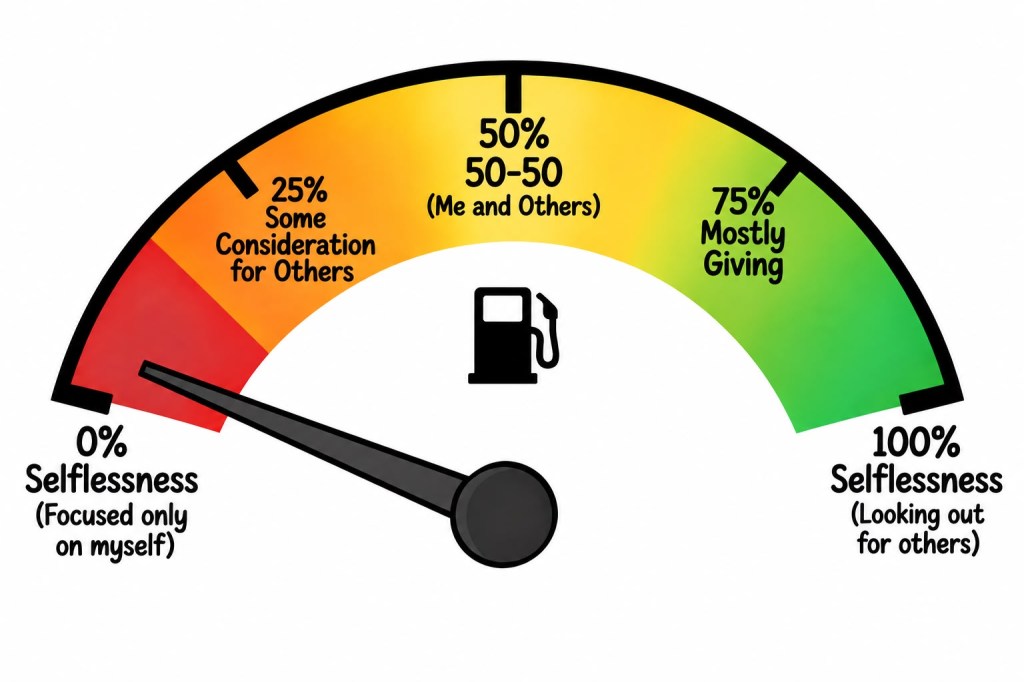
The illustration shows a gauge moving from focusing only on yourself to looking out for others.
But there is something important to remember.
Taking care of yourself does not mean you don’t care about other people.
You can care about others and still have needs of your own.
You can love your family and still need rest.
You can appreciate your caregiver and still need boundaries.
You can want to help someone and still say, “I can’t today.”
These things can exist together.
🧠 Brain Injury Changes What You Can Give
Before your injury, you may have had more capacity.
You could work all day.
Take care of the house.
Run errands.
Socialize.
Answer messages.
Help other people.
Then your brain injury happened.
Now those same activities may require much more energy.
Your capacity may change from day to day.
One day you might have enough energy to help someone.
The next day, getting through your own routine may be all you can manage.
That doesn’t make you selfish.
It means your available resources have changed.
🔋 You Can’t Give From an Empty Battery
Think about the energy gauge we talked about before.
If you wake up with only 25% energy, giving 100% of that remaining energy to everyone else leaves nothing for you.
Eventually, you may become exhausted.
Frustrated.
Overwhelmed.
Angry.
Or completely depleted.
Taking care of yourself isn’t taking something away from other people.
Sometimes, self-care is what allows you to keep participating in the relationships and activities that matter to you.
🤝 The 50/50 Middle Ground
The middle of the gauge can be a helpful place to think about.
Me and others.
Not only me.
Not only everyone else.
Both.
There may be times when someone else needs you.
And there may be times when you need you.
You can ask:
“What do I need right now?”
Then ask:
“What can I reasonably give right now?”
Those questions can help you find a healthier balance.
🛑 You Are Allowed to Say No
Saying no can be especially difficult when you are used to being the helper.
But “no” doesn’t automatically mean rejection.
It can mean:
“I don’t have the energy today.”
“I need to rest.”
“I can’t take this on right now.”
“I need someone to help me instead.”
“I can help another time.”
Your limits are information.
They tell you what your brain and body can handle.
🌱 Stop Measuring Your Worth by How Much You Give
You are more than what you do for other people.
You don’t have to constantly give to deserve love.
You don’t have to be productive to deserve rest.
You don’t have to solve everyone’s problems to be valuable.
And you don’t have to apologize for having needs.
You are a person, not a resource.
💗 Caring for Yourself Helps You Stay Connected
When we protect our energy, we may have more capacity for the people and things that truly matter.
Maybe that means resting before visiting family.
Maybe it means asking someone else to run an errand.
Maybe it means shortening a social visit.
Maybe it means turning off your phone for a while.
Maybe it means allowing someone to care for you.
Receiving care can feel uncomfortable when you’ve spent your life giving it.
But receiving is part of being human too.
✨ You Belong on the Gauge Too
If you have a brain injury, you may already spend so much time thinking about what everyone else needs from you.
Today, try asking a different question:
“What do I need from me?”
Maybe the answer is rest.
Maybe it’s patience.
Maybe it’s help.
Maybe it’s forgiveness.
Maybe it’s simply permission to have a slower day.
Whatever the answer is, listen to it.
You matter too.
You can care for others without abandoning yourself.
You can be generous without becoming depleted.
You can love people while protecting your own energy.
And you can make space for yourself without feeling guilty.
💗 Love Love Brain Note
Every brain injury is different. The ideas in this post are for educational and supportive purposes only and are not medical advice or a substitute for individualized care from qualified healthcare professionals. If you are experiencing new, severe, worsening, or concerning symptoms, seek appropriate medical care.


Do you Love Love YOUR Brain?