
“You don’t need to know what it is to know that it is.”
Dr. David Grand
Sometimes after a brain injury, PTSD, or trauma, we feel overwhelmed by emotions we can’t explain.
💔 We know something is wrong.
💭 We just can’t always put it into words.
That doesn’t mean it isn’t real.
Those feelings may live deeper in the brain than language itself.
This is one of the beautiful ideas behind Brainspotting, developed by Dr. David Grand in 2003.
👁️ What is Brainspotting?
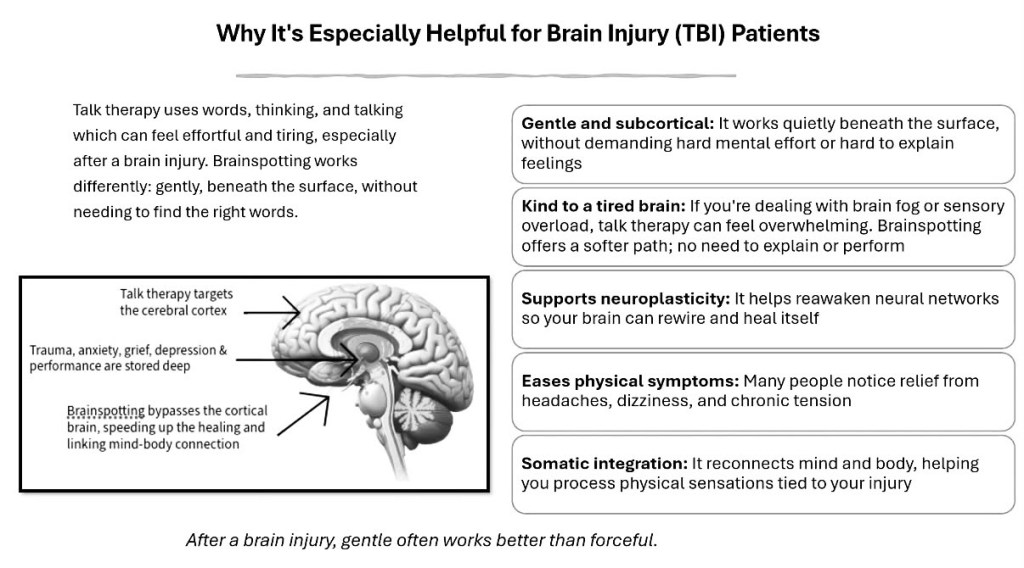
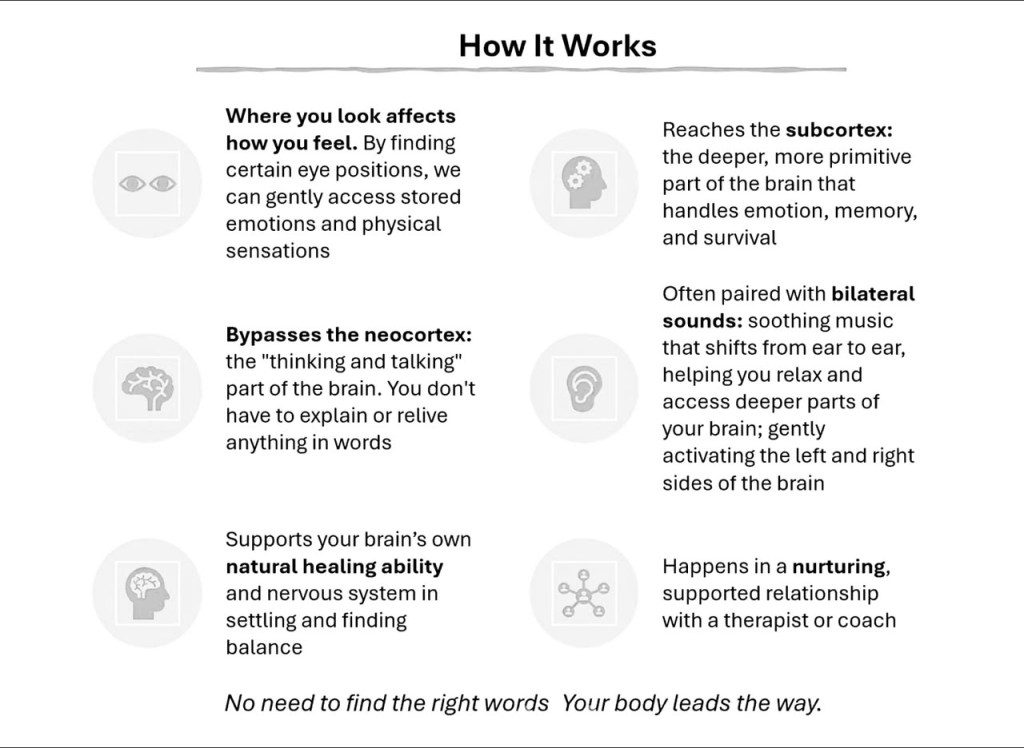
Brainspotting is a gentle, brain-body therapy that uses specific eye positions to help access areas of the brain where emotions, trauma, and stress may be stored.
It grew from EMDR but developed into its own unique approach.
Rather than talking your way through every feeling, Brainspotting allows your brain and nervous system to do much of the work naturally.
🧠 Why might it help after TBI?
Many brain injury survivors say:
💭 “I know something feels wrong…”
😢 “I start crying but don’t know why.”
😡 “I get angry before I even realize I’m upset.”
😶 “I can’t find the words.”
After a TBI, the thinking part of the brain and the emotional parts of the brain don’t always communicate easily.
Brainspotting recognizes that healing doesn’t always begin with words.
Sometimes your brain already knows what needs attention, even when your conscious mind doesn’t.
❤️ Healing without forcing it
One reason many people appreciate Brainspotting is that there is no pressure to explain everything.
You don’t have to remember every detail.
You don’t have to have the perfect story.
You don’t even have to know exactly what you’re feeling.
You simply notice what is happening in your body while your therapist helps guide the process.
🌿 The nervous system matters
Trauma, chronic stress, PTSD, and brain injury can leave our nervous system stuck in survival mode.
Brainspotting aims to help the nervous system settle so the brain can process experiences that may have remained “unfinished.”
Many people describe feeling:
✨ Calmer
✨ More grounded
✨ Less emotionally reactive
✨ Better able to sleep
✨ More connected to themselves
Everyone’s experience is different, and Brainspotting is not a cure for brain injury. However, many survivors find it to be a valuable part of a comprehensive recovery plan alongside medical care, therapy, exercise, sleep, and healthy lifestyle habits.
♥️ Love Love Brain Thought
Healing doesn’t always happen through understanding.
Sometimes it happens through allowing.
As Dr. David Grand reminds us:
“You don’t need to know what it is to know that it is.”
If you’ve been carrying emotions you can’t explain, please remember:
💗 Your feelings are real.
🧠 Your brain is still trying to protect you.
🌱 Healing is possible, one gentle step at a time.
At Love Love Brain, we believe every survivor deserves hope, compassion, and the chance to heal at their own pace.
With love,
Adeline (add-ah-LEAN) 👑
Founder, Love Love Brain ♥️♥️🧠



Do you Love Love YOUR Brain?