
What if the brain is not as fixed as we once believed?
What if the brain can adapt, reorganize, and find new ways to function after injury or disease?
These questions are at the heart of The Brain That Changes Itself: Stories of Personal Triumph from the Frontiers of Brain Science by Norman Doidge, M.D.
The book explores the science of neuroplasticity, the brain’s ability to change its structure and function in response to experience, learning, and circumstances.
Through stories of people facing neurological challenges, Dr. Doidge introduces readers to scientists, physicians, therapists, and patients whose experiences have helped challenge traditional ideas about the brain.
For people living with brain injury, the book can offer an encouraging perspective: the brain is capable of change.
🧠 The Brain Is Not Always Fixed
For a long time, scientists believed that the adult brain had very limited ability to reorganize itself.
The idea of neuroplasticity challenged that assumption.
The brain can create new connections, strengthen existing pathways, and sometimes reorganize how certain functions are carried out.
This doesn’t mean that every brain injury can be completely reversed.
It doesn’t mean recovery will happen quickly.
And it doesn’t mean that the same approach will work for everyone.
But it does give us a different way to think about the brain.
Change can remain possible.
🌱 What Is Neuroplasticity?
Neuroplasticity refers to the brain’s ability to change and adapt.
Our experiences, behaviors, learning, and environment can influence the way the brain functions.
For someone recovering from a brain injury, this idea can be especially meaningful.
Recovery may involve learning something again.
Learning something differently.
Finding a new strategy.
Creating a new routine.
Or discovering another pathway to accomplish an everyday task.
The brain may not simply be returning to what it was before.
It may be adapting to what is now.
💔 When the Brain Changes, Life Changes
A neurological injury doesn’t only affect one part of a person’s life.
It can affect:
🧠 Thinking
💬 Communication
🚶 Movement
👀 Sensory processing
❤️ Emotions
💼 Work
🤝 Relationships
🏡 Independence
When these abilities change, the person may have to rethink how they navigate everyday life.
That process can be exhausting.
But it can also lead to new discoveries about what the brain and the person are capable of.
📖 Stories of People Who Refused to Give Up
One of the most engaging aspects of The Brain That Changes Itself is its use of individual stories.
Rather than presenting neuroplasticity only as a scientific concept, Dr. Doidge explores real people whose lives were affected by neurological conditions.
Their experiences help bring the science to life.
Readers can see how researchers and clinicians have explored new ways of working with the brain.
And they can see how patients have sometimes made changes that once seemed unlikely.
These stories don’t provide a guarantee of recovery.
But they can provide perspective.
🔄 The Brain Can Learn New Pathways
Sometimes the brain needs to find another way.
After an injury, a function that once happened automatically may become difficult.
A survivor may need to approach the task differently.
Rehabilitation can involve repetition, practice, sensory input, movement, and learning.
Over time, these experiences can help the brain adapt.
This is one reason rehabilitation can require patience.
The brain may be learning something that used to happen without conscious effort.
💪 Recovery Requires Patience
Neuroplasticity isn’t a magic solution.
Change takes time.
It can require repeated practice and consistent effort.
There can also be setbacks.
Some days may feel productive.
Other days may feel like nothing is happening.
That doesn’t necessarily mean the brain isn’t learning.
Recovery can be difficult to measure from one day to the next.
Sometimes progress becomes clearer only when you look back.
🌻 Small Changes Matter
One of the most encouraging ideas to take from neuroplasticity is that small changes can matter.
Maybe you can:
🖐️ Move a little more
🧠 Remember something more easily
💬 Find a word faster
🚶 Walk a little farther
👕 Complete part of a daily task independently
These may seem like small accomplishments.
But for someone recovering from a brain injury, they can represent significant work happening beneath the surface.
Every small step can be part of a larger process.
💭 Don’t Define Yourself by What You Cannot Do
Brain injury can make it very easy to focus on limitations.
You may think about everything that has changed.
Everything you can’t do.
Everything that takes longer.
Everything you wish you could return to.
But neuroplasticity offers another question:
What might still be possible?
That doesn’t mean ignoring limitations.
It means leaving room for curiosity.
Instead of assuming that today’s ability is permanently fixed, we can ask what strategies, therapies, adaptations, or supports might help.
❤️ Hope With Realistic Expectations
At Love Love Brain, we think it’s important to separate hope from promises.
The Brain That Changes Itself can inspire hope because it introduces readers to the remarkable adaptability of the brain.
But every person’s injury is different.
Recovery depends on many factors.
Neuroplasticity doesn’t guarantee a particular outcome.
The book is best understood as an exploration of what science and individual experiences can teach us about the brain’s capacity for change.
🤝 Why This Matters to Families and Caregivers
Neuroplasticity isn’t only important for survivors.
Caregivers and families can benefit from understanding that recovery may involve ongoing learning and adaptation.
A survivor may need:
⏳ More time
🔄 More repetition
🗣️ Different communication strategies
🌱 Different expectations
❤️ Encouragement without pressure
Understanding this can make it easier to celebrate progress rather than focusing only on what has not yet returned.
🦋 Becoming Someone New
Recovery isn’t always about returning to exactly who you were before.
Sometimes the brain injury changes the path.
You may discover new strategies.
New interests.
New strengths.
New ways of connecting with people.
New ways of contributing.
The person you become after an injury may not be identical to the person you were before.
That doesn’t mean the new version of you is less valuable.
💗 Love Love Brain Thoughts
The Brain That Changes Itself gives readers a powerful reason to remain curious about the brain.
It reminds us that the brain is dynamic.
It can learn.
It can adapt.
It can respond to experience.
For someone living with brain injury, that idea can be deeply meaningful.
Your recovery may not happen the way you imagined.
It may not happen as quickly as you want.
And it may not look like someone else’s recovery.
But there may still be room for learning and change.
At Love Love Brain, we believe hope doesn’t mean pretending that recovery is easy.
Hope means leaving space for possibility.
It means recognizing the small victories.
It means being patient with your brain.
It means remembering that your current limitations do not necessarily tell the entire story of your future.
Your brain has changed.
And you are still changing, too.
💬 We’d Love to Hear From You
Have you experienced a change in your abilities that surprised you?
Have you discovered a new way of doing something after your brain injury?
What small change has given you hope during your recovery?
Share your experience in the comments.
Your story may be exactly what another survivor needs to hear today.
📖 Where to Find the Book
If you’d like to learn more about The Brain That Changes Itself: Stories of Personal Triumph from the Frontiers of Brain Science, you can find it through major book retailers.
🛒 Get the Book on Amazon
Love Love Brain may earn a small commission from qualifying purchases made through this link. This does not affect the price you pay.
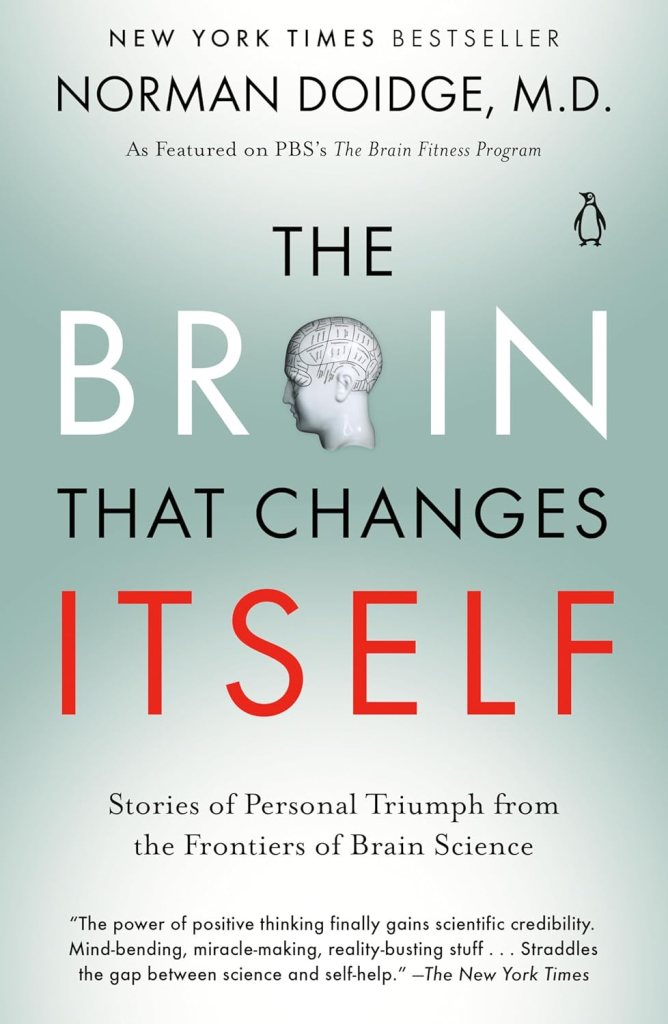
Book cover belongs to the publisher and is displayed for identification and review purposes.
Note: This book review is for educational and reflective purposes only and is not medical advice or a substitute for individualized care, diagnosis, treatment, or guidance from a qualified healthcare professional. Every brain injury and recovery journey is different. The experiences and information discussed in this review should not be used to diagnose or treat a medical condition or to replace recommendations from your healthcare team.


Do you Love Love YOUR Brain?