
Life doesn’t always go according to plan.
Sometimes something happens that changes everything.
An accident.
An illness.
A loss.
A relationship ending.
A major disappointment.
A brain injury.
And suddenly, the life you knew doesn’t feel quite the same.
The question becomes:
“How do I move forward from here?”
Bouncing Back: Rewiring Your Brain for Maximum Resilience and Well-Being by Linda Graham, MFT explores resilience through the lens of neuroscience, psychology, relationships, mindfulness, and practical exercises.
Graham’s central message is hopeful: resilience isn’t simply something you’re born with. Patterns of response can be learned, and the brain has the capacity to develop new patterns.
📖 What Does It Mean to Bounce Back?
“Bouncing back” doesn’t necessarily mean returning to exactly who you were before something happened.
Sometimes it means finding a way forward.
You may not be able to erase what happened.
But you can learn new ways to respond.
You can build new skills.
You can develop support.
You can become more aware of your reactions.
And you can gradually create a greater sense of stability.
🧠 The Brain Can Learn New Patterns
One of the central ideas in Bouncing Back is that patterns that become established in the brain are not necessarily permanent.
Graham draws on neuroscience to explain how resilience can be strengthened and how previously learned patterns can be changed.
This is often described through the concept of neuroplasticity.
The brain can change in response to experience, learning, and practice.
That doesn’t mean we can simply think our way out of every problem.
It means the brain has a capacity for adaptation.
💔 When Something Changes Your Life
After a major life event, your nervous system may remain on high alert.
You may become more anxious.
You may expect something bad to happen.
You may avoid situations.
You may struggle to trust.
You may feel overwhelmed more easily.
These responses can become patterns.
Understanding them can be the first step toward changing them.
🌪️ Stress Can Change How We Respond
When you’re overwhelmed, your brain may have less capacity for thoughtful decision-making.
You may react before thinking.
You may become defensive.
You may shut down.
You may want to escape.
After brain injury, these reactions can sometimes become even more complicated because the injury itself may affect emotional regulation and cognitive control.
That is why self-compassion matters.
🤝 Connection Helps Us Heal
Graham places significant emphasis on relationships, empathy, and connection.
Humans are not designed to recover from difficult experiences entirely alone.
Support can help regulate stress.
Being understood can reduce isolation.
A safe relationship can remind you that you don’t have to face everything by yourself.
For brain injury survivors, this can be especially important.
❤️ Self-Acceptance Is Part of Resilience
Resilience isn’t pretending you’re okay.
It isn’t forcing positivity.
It isn’t telling yourself:
“Other people have it worse.”
It is being able to acknowledge:
“This is difficult.”
And then asking:
“What do I need now?”
That is a very different approach.
🧘 Mindfulness and Awareness
Mindfulness can help create a little distance between what happens and how we respond.
You notice:
“I’m becoming overwhelmed.”
Instead of immediately reacting, you may be able to pause.
Breathe.
Notice.
Choose.
That pause can become a new pattern.
🧩 Building Resilience Through Small Steps
Graham’s approach includes practical exercises designed to help readers develop skills related to resilience and well-being.
That matters because resilience isn’t just an idea.
It is something we practice.
A small pause.
A supportive conversation.
A healthier response.
A new routine.
A different way of interpreting an event.
Small changes can accumulate.
🧠 Brain Injury Can Challenge Resilience
A TBI can create challenges that aren’t simply emotional.
You may have cognitive symptoms.
Physical symptoms.
Fatigue.
Pain.
Sensory difficulties.
Communication problems.
Changes in identity.
These challenges can affect your ability to cope.
Sometimes the most resilient thing you can do is recognize that your brain needs rest.
⏸️ Rest Is Not Giving Up
There is a difference between giving up and slowing down.
After brain injury, pushing constantly can make recovery harder.
Rest can be part of the strategy.
You don’t have to prove your strength by exhausting yourself.
Sometimes resilience looks like saying:
“That’s enough for today.”
🌱 Resilience Doesn’t Mean You Never Struggle
You can be resilient and still cry.
You can be resilient and still feel angry.
You can be resilient and still have bad days.
You can be resilient and still need help.
Resilience is not the absence of difficulty.
It is the capacity to respond to difficulty and continue moving forward.
💡 You Can Learn New Ways to Respond
Maybe you used to react immediately.
Now you pause.
Maybe you used to isolate yourself.
Now you reach out.
Maybe you used to criticize yourself.
Now you practice self-compassion.
Maybe you used to push through exhaustion.
Now you listen to your body.
Those are changes.
They count.
🌻 Bouncing Forward, Not Backward
Sometimes “bouncing back” can sound like returning to exactly who you were before.
But life doesn’t always work that way.
After a brain injury, you may not return to the same version of yourself.
Instead, you may build something new.
A different routine.
Different priorities.
Different strengths.
A different understanding of what matters.
💗 Love Love Brain Thoughts
Bouncing Back offers a hopeful perspective on resilience, explaining how learned patterns can become established in the brain while also drawing on neuroscience to show how new patterns can be developed. Graham combines explanations with exercises intended to help readers cultivate clarity, connection, competence, calm, and courage.
For Love Love Brain, the idea of resilience is especially meaningful.
But we want to redefine what “bouncing back” means.
It doesn’t have to mean becoming exactly who you were before your injury.
Sometimes resilience means learning to live differently.
It means adapting.
Asking for help.
Resting.
Trying again.
Changing strategies.
And accepting that progress may not always look dramatic.
You don’t have to bounce back to your old life.
You can move forward into a new one.
At Love Love Brain, we believe that resilience isn’t about being strong every day.
It is about continuing to care for yourself even on the days when you don’t feel strong.
💬 We’d Love to Hear From You
What has helped you become more resilient after brain injury or another major life change?
Has your definition of “strength” changed?
What does bouncing back mean to you now?
Share your experience in the comments.
Your story may help someone else find hope.
📖 Where to Find the Book
Bouncing Back: Rewiring Your Brain for Maximum Resilience and Well-Being was published by New World Library in 2013 and is approximately 433–464 pages depending on the edition. It received the 2013 Books for a Better Life Acorda Wellness Award and the 2014 Silver Nautilus Book Award.
🛒 Get the Book on Amazon
Love Love Brain may earn a small commission from qualifying purchases made through this link. This does not affect the price you pay.
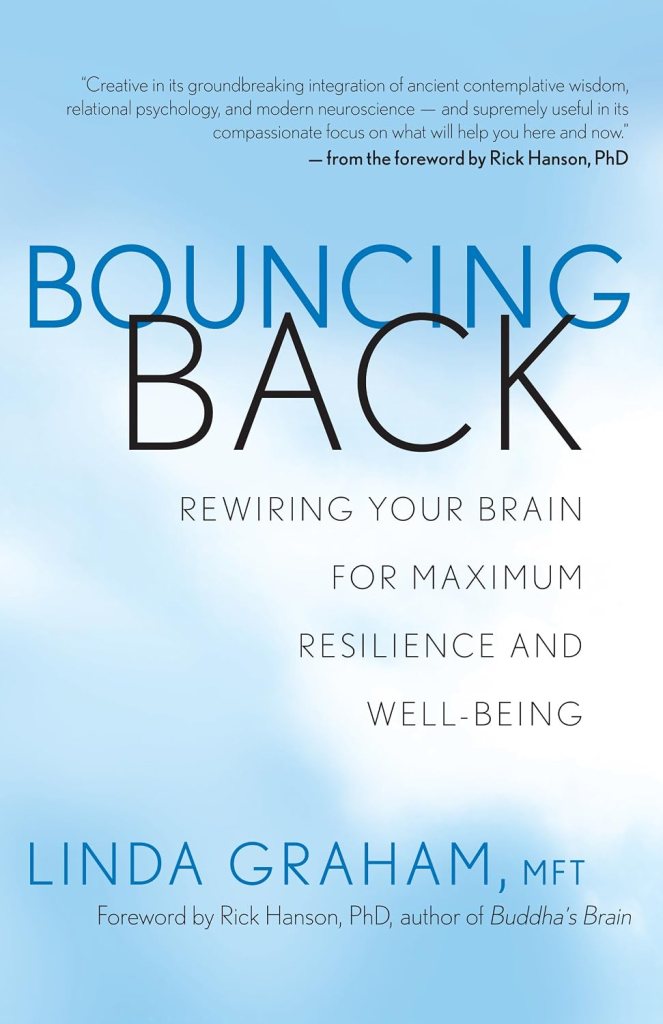
Book cover belongs to the publisher and is displayed for identification and review purposes.
Note: This book review is for informational and educational purposes only. It is not medical advice and should not replace guidance from a qualified healthcare professional. Every brain injury and recovery journey is different.


Do you Love Love YOUR Brain?