
After a brain injury, your emotional “fuel gauge” can look very different from someone else’s.
A person without a brain injury might wake up feeling relatively refreshed and have enough energy to handle the normal demands of the day.
They might get up, shower, make breakfast, go to work, answer messages, deal with traffic, and have a difficult conversation without feeling completely overwhelmed.
For many people living with brain injury, the day can begin differently.
🔋 Starting the Day With a Low Battery
Imagine that most people wake up with something close to a full battery.
Of course, illness, poor sleep, stress, pain, or other challenges can lower that battery.
But for someone with a brain injury, the starting point can already be much lower.
You might wake up with only 25% of your energy available.
And you haven’t even gotten out of bed yet.
You still have to get up.
You have to get to the bathroom.
You have to brush your teeth.
You have to get dressed.
You may need to take medications, prepare food, manage appointments, communicate with caregivers, or simply figure out what the day is asking from you.
That means you can become depleted much faster.
You are not starting the day from the same place as everyone else.
And that matters.
🧠 When Your Battery Is Low, Everything Can Feel Bigger
When your brain is already working hard to manage basic activities, additional stress can become much harder to handle.
A small frustration can feel enormous.
A noisy room can become overwhelming.
A simple question can feel like too much.
A change in plans can trigger anxiety.
Someone else’s impatience can push you closer to your limit.
You may find yourself becoming angry, frustrated, withdrawn, or completely exhausted.
This does not mean you are a bad person.
It may mean your system is overloaded.
🌡️ Think of Your Emotions Like a Gauge
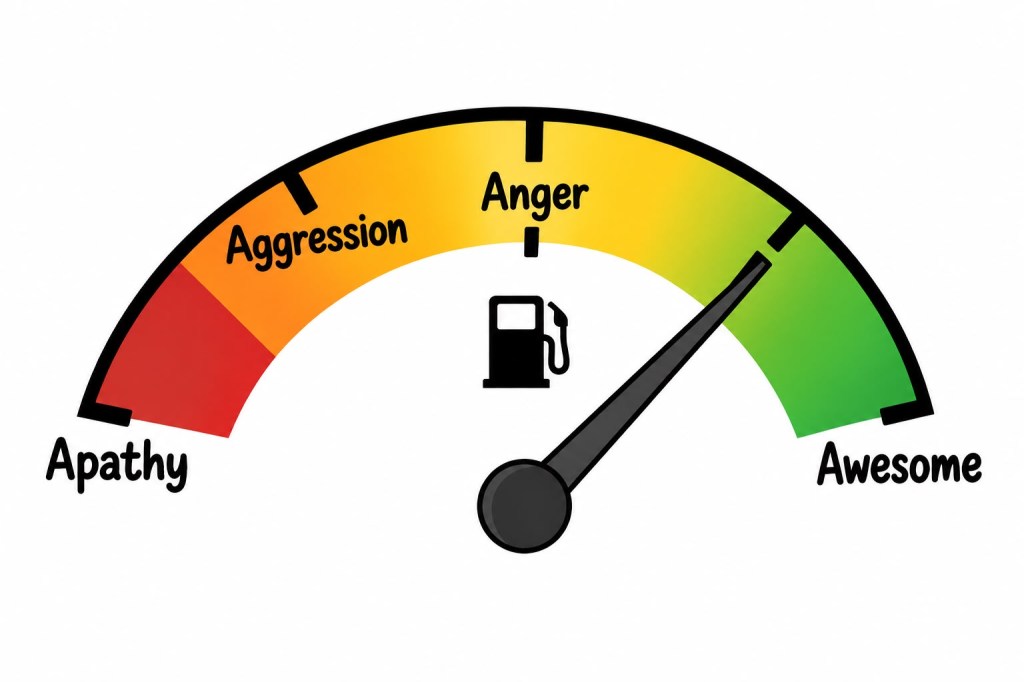
The illustration accompanying this post shows a gauge moving from apathy, through anger and aggression, toward awesome.
It is a simple visual reminder that our emotional state can change.
We can move toward frustration.
We can move toward anger.
We can also move back toward calm, connection, and feeling more like ourselves.
The important thing is learning to notice where you are on the gauge before you reach the point of no return.
Ask yourself:
🧠 How overwhelmed am I right now?
🔋 How much energy do I have left?
😴 Did I sleep well?
😣 Am I dealing with pain?
🔊 Is there too much noise or stimulation?
💗 Have I had enough time to rest?
🤝 Do I need help?
🛑 Do I need to stop before I become completely depleted?
These questions are not weakness.
They are self-awareness.
💗 Low Battery Means We Need More Care
One of the most important things we can learn after brain injury is that rest is not a reward for finishing everything.
Sometimes rest is what allows us to do anything at all.
If someone starts their day with significantly less energy, it makes sense that they may need more breaks, more patience, and more support.
This is why caregivers, family members, friends, and professionals can make such a difference.
Instead of saying:
“Why can’t you just do it?”
Try asking:
“What do you need right now?”
Instead of assuming someone is being difficult, consider whether their brain is simply exhausted.
Instead of pushing harder, sometimes the better answer is to reduce the demands.
🤝 Treat the Person, Not Just the Behavior
When someone with a brain injury becomes irritable or angry, it can be tempting to focus only on the behavior.
But there may be something underneath it.
Pain.
Fatigue.
Sensory overload.
Confusion.
Fear.
Frustration.
Communication difficulties.
Too many demands.
Not enough recovery time.
The anger may be the visible part of the problem.
The depleted brain underneath it may be the part that needs attention.
That doesn’t mean harmful behavior should be ignored. Boundaries still matter. Safety still matters.
But understanding what is happening can help us respond with more compassion and less judgment.
🌱 Protect Your Remaining Energy
If you begin the day with a low battery, protecting your energy becomes part of your recovery strategy.
You might need to:
🌿 Take breaks before you feel exhausted.
🤫 Build quiet time into your day.
✂️ Reduce unnecessary commitments.
🎯 Do one thing at a time.
🤝 Ask someone to help with tasks.
⏳ Give yourself extra time to get ready.
🌤️ Limit overwhelming environments when possible.
😴 Pay attention to sleep and rest.
💭 Notice your emotional warning signs.
You don’t have to use every last drop of energy just because you have it.
Save some for later.
🛑 You Don’t Have to Reach the Red Zone
The goal isn’t to wait until you are completely overwhelmed and then try to recover.
The goal is to recognize the warning signs earlier.
Maybe your jaw starts tightening.
Maybe your thoughts become faster.
Maybe you become more sensitive to noise.
Maybe you stop wanting to talk.
Maybe everything suddenly feels irritating.
These can be signals that your battery is getting low.
That is your opportunity to pause.
Stop. Breathe. Rest. Ask for help.
You are allowed to step away before you reach the red zone.
✨ Your Capacity Is Not Your Worth
This is something every brain injury survivor deserves to remember.
Your capacity may change from day to day.
Some days you may feel capable of doing many things.
Other days, brushing your teeth and getting dressed may be enough.
That doesn’t make you lazy.
It doesn’t make you less intelligent.
It doesn’t make you less valuable.
It means your brain and body have different needs now.
Your worth has never been measured by how much you can accomplish in one day.
💗 A Little More Compassion
Maybe the person with the low battery is you.
Maybe it is your spouse.
Maybe it is your parent.
Maybe it is your child.
Maybe it is someone you care for.
Whatever the situation, remember this:
A brain injury can change how much energy a person has available for the ordinary things in life.
When we understand that, we can replace judgment with compassion.
We can give people more time.
More patience.
More rest.
More support.
And sometimes, that little bit of understanding can make the difference between reaching the anger zone and finding our way back toward awesome.
⚠️ Love Love Brain Note
Every brain injury is different. The experiences and ideas discussed in this post are for educational and supportive purposes only and are not medical advice or a substitute for individualized care from qualified healthcare professionals. If you are experiencing new, severe, worsening, or concerning symptoms, seek appropriate medical care.


Do you Love Love YOUR Brain?