
How often do we feel like we are running out of time?
There is always something else to do.
Another message to answer.
Another appointment.
Another responsibility.
Another thing we should have finished already.
Sometimes life after brain injury can make that pressure even harder.
You may want to keep up.
You may want to get back to your old routine.
You may want to prove that you can still do everything you used to do.
And when your brain or body says, “Slow down,” you may find yourself asking:
“Why can’t I do what I used to do?”
“Why do I feel like I am always behind?”
“Am I doing enough?”
“Can I slow down without feeling guilty?”
“What if resting is not falling behind?”
In An Unhurried Life: Following Jesus’ Rhythms of Work and Rest, Alan Fadling explores what it means to step away from a life dominated by hurry and learn a different rhythm of work, rest, prayer, and relationship.
This is a Christian book, rooted in the life and teachings of Jesus.
It is not a book about brain injury.
But its invitation to reconsider hurry, productivity, rest, and the way we live can speak to anyone whose life has been forced to slow down.
And at the heart of the book is a simple question:
What if we did not have to hurry through our lives?
🕊️ What If We Stopped Rushing?
Hurry can become so normal that we stop noticing it.
We rush through breakfast.
We rush through conversations.
We rush through work.
We rush through rest because we are already thinking about what comes next.
Eventually, being busy can begin to feel like proof that we are doing something important.
But Fadling asks us to question that pattern.
Maybe productivity and worth are not the same thing.
Maybe being busy does not automatically mean we are living well.
And maybe slowing down can create space for things that hurry makes difficult to notice.
🧠 Life After Brain Injury Can Require a Different Pace
For many people living with brain injury, slowing down is not simply a lifestyle preference.
It can become a necessity.
The brain may need more time to process information.
Fatigue may arrive sooner.
Too much noise or stimulation can become overwhelming.
A full schedule may leave little energy for anything else.
And yet, the pressure to “keep up” can remain.
That can create a difficult conflict.
Your body is asking for less.
Your mind is telling you that you should be doing more.
Learning to listen to your limits can take courage.
⏳ Rest Is Not Failure
Sometimes rest feels like something we have to earn.
We tell ourselves:
“I’ll rest when I’m finished.”
“I’ll rest when everything is done.”
“I’ll rest when I feel productive enough.”
But there is a problem with that plan.
Everything is rarely finished.
There is almost always another task.
Another email.
Another appointment.
Another responsibility.
Fadling’s approach challenges the idea that work must always come first.
For someone recovering from brain injury, that can be a powerful reminder.
Rest does not mean you have failed.
Sometimes rest is part of taking care of yourself.
🌿 There Is a Difference Between Slow and Stuck
Slowing down can feel uncomfortable.
Especially if you are used to measuring yourself by what you accomplish.
But being slower does not necessarily mean you are going nowhere.
You may simply be moving at a pace that your brain and body can sustain.
That can be an important distinction.
Recovery is not always fast.
Healing is not always linear.
Progress is not always visible.
Sometimes progress looks like knowing when to stop before you become completely exhausted.
❤️ You Do Not Have to Prove Your Worth
Brain injury can create a painful relationship with productivity.
You may compare yourself to the person you were before your injury.
You may compare yourself with friends.
You may compare yourself with coworkers.
You may look at everything you used to accomplish and wonder why you cannot do the same amount now.
But your worth was never measured by your to-do list.
You do not become less valuable because you need more breaks.
You do not become less capable because you need accommodations.
You do not become less worthy because your life looks different.
🙏 Making Room for Stillness
Fadling’s book draws deeply from Christian spirituality and the life of Jesus.
For Christian readers, this perspective may offer a meaningful invitation to slow down and make more room for prayer, reflection, relationship, and rest.
And even within a recovery journey, stillness can create a different kind of space.
A space to breathe.
A space to notice.
A space to listen.
A space to stop measuring every moment by productivity.
🌻 Five Unhurried Minutes
One of the ideas associated with the book is taking “five unhurried minutes.”
We love the simplicity of that idea.
You do not necessarily have to transform your entire life overnight.
Maybe you begin with five minutes.
Five minutes without rushing.
Five minutes sitting quietly.
Five minutes outside.
Five minutes with a cup of tea.
Five minutes of prayer.
Five minutes simply noticing how you feel.
Small moments of slowing down can still matter.
🏡 There Is More to Life Than Getting Things Done
Sometimes recovery can accidentally become another performance.
We create goals.
We track progress.
We count what we can do.
We compare today’s abilities with yesterday’s.
And before we know it, recovery itself becomes another reason to hurry.
But life is not only about what we accomplish.
There are relationships.
There are quiet moments.
There is laughter.
There is nature.
There is music.
There are conversations.
There are ordinary moments that do not produce anything measurable.
They are still part of a meaningful life.
🌱 Finding a Sustainable Rhythm
Perhaps one of the most useful questions to take from this book is:
“What pace can I actually sustain?”
Not what pace worked before your injury.
Not what pace someone else expects from you.
Not what pace makes you look productive.
What pace allows you to live without constantly pushing yourself beyond your limits?
That answer may change from day to day.
And that is okay.
💗 You Are Allowed to Live at Your Own Pace
Maybe one of the hardest lessons after brain injury is learning that your pace may have changed.
That does not mean your life has ended.
It means you may need to discover a different rhythm.
A sustainable rhythm.
A gentler rhythm.
A rhythm that leaves room for rest.
A rhythm that respects what your brain and body are telling you.
You do not have to live someone else’s timeline.
💗 Love Love Brain Thoughts
We think An Unhurried Life speaks beautifully to one of the pressures that can be especially difficult after brain injury: the pressure to hurry back to who you were.
Sometimes we are so focused on getting better that we forget to ask whether the pace we are using is actually kind to ourselves. Fadling’s message about work, rest, and resisting hurry gives us an opportunity to think about recovery differently. Instead of asking, “How quickly can I get back to normal?” we can sometimes ask, “What rhythm allows me to live well with the life I have today?”
This is a Christian book, so its spiritual perspective will resonate most strongly with readers who appreciate reflection through the teachings and example of Jesus. It is not a medical book about brain injury, and it should not be treated as a treatment for fatigue or other symptoms. But as a reflection on hurry, rest, purpose, and the pressure to constantly produce, it can offer meaningful questions for anyone whose life has been changed by brain injury.
Maybe an unhurried life is not a life where nothing gets done.
Maybe it is a life where we stop believing that everything has to be done right now.
💬 We’d Love to Hear From You
Do you find it difficult to slow down?
Has brain injury changed the pace at which you live?
Do you ever feel guilty for resting?
What does an “unhurried” day look like for you?
What is one thing you could give yourself permission to do more slowly?
📖 Where to Find the Book
An Unhurried Life: Following Jesus’ Rhythms of Work and Rest was written by Alan Fadling and published by InterVarsity Press. The book explores the rhythms of work and rest through a Christian perspective and encourages readers to reconsider the hurry and pressure that can shape everyday life.
🛒 Get the Book on Amazon
Love Love Brain may earn a small commission from qualifying purchases made through our book recommendations. This helps support our work.
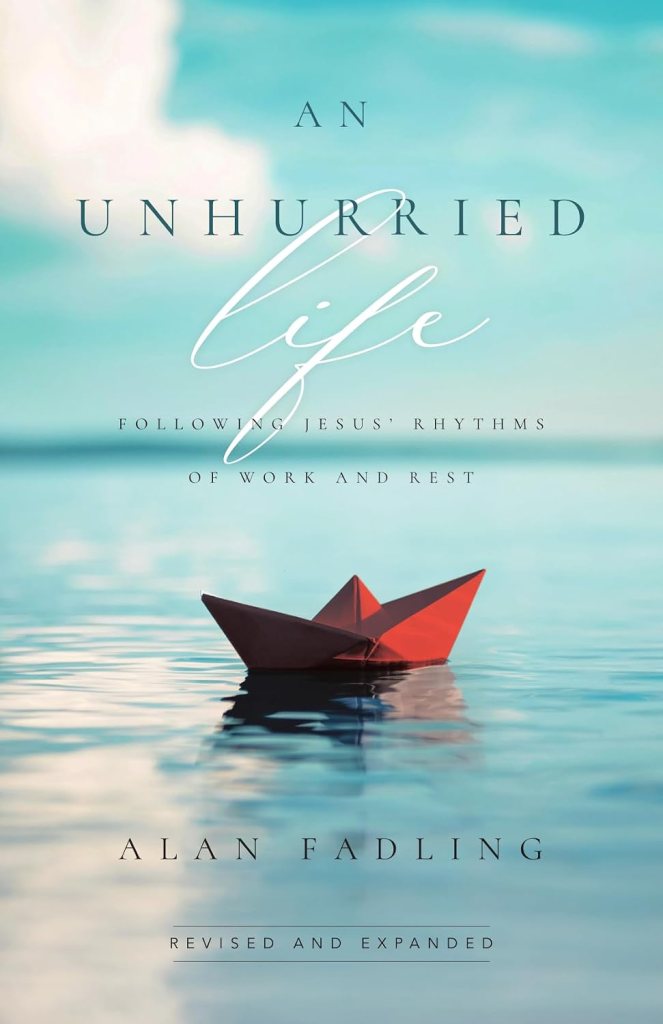
Book cover belongs to the publisher and is displayed for identification and review purposes.
Note: This book review is for informational and educational purposes only. It is not medical advice and should not replace guidance from a qualified healthcare professional. Every brain injury and recovery journey is different.


Do you Love Love YOUR Brain?