
Understanding our nervous system after trauma and brain injury.
Have you ever wondered why you suddenly feel anxious, angry, overwhelmed, disconnected, or desperate to please everyone?
Perhaps your heart races, your thoughts disappear, or you find yourself agreeing to something you don’t really want to do.
You are not choosing these reactions. Your nervous system may be trying to protect you.
One helpful way to understand these responses is through Polyvagal Theory.
Developed by neuroscientist Dr. Stephen Porges, this theory explores how our nervous system responds to feelings of safety and danger.
And yes! FAWN absolutely belongs in our conversation. ♥️
Although fawning is not one of the original three states described in Polyvagal Theory, it is widely discussed as a trauma-related survival response.
Let’s explore all five responses with compassion, curiosity, and LOVE LOVE.
🌈 Our Five Responses to Stress and Trauma
🥊 1. FIGHT: “I must defend myself!”
Our nervous system prepares us to confront a perceived threat.
We might experience:
😠 Anger, frustration, or irritability.
🛡️ Defensiveness.
🗣️ A sudden urge to argue.
After a brain injury, even a small correction or unexpected demand may feel enormous.
♥️ Love Love Reminder: Anger can be a signal that we’re overwhelmed. We can learn to pause before responding.
🏃 2. FLIGHT: “I need to escape!”
Our body wants to move away from danger.
We might experience:
😰 Anxiety or panic.
💭 Racing thoughts.
😣 Restlessness.
🚪 An overwhelming desire to leave.
Crowded restaurants, loud noises, difficult conversations, or too many responsibilities may trigger this response.
♥️ Love Love Reminder: Taking a break is sometimes the healthiest decision we can make.
🧊 3. FREEZE: “I can’t move!”
Sometimes our nervous system becomes overwhelmed, and we feel unable to act.
We might experience:
😶 Numbness or disconnection.
🗣️ Difficulty speaking.
🧠 Mental blankness.
🧍 Feeling stuck.
Some people also experience dissociation, where they feel detached from themselves or their surroundings.
♥️ Love Love Reminder: When we cannot move forward, we may need safety, support, and time rather than more pressure.
🤝 4. FAWN: “I must keep everyone happy!”
Fawning is a response in which we try to protect ourselves by pleasing, agreeing with, or accommodating others.
We might:
🙏 Apologize excessively.
🤝 Avoid disagreements.
🙋 Say yes when we mean no.
💗 Put everyone else’s needs before our own.
Sometimes, keeping another person happy feels safer than expressing our true feelings.
Fawning is different from genuine kindness. Kindness comes from choice. Fawning is often driven by fear.
♥️ Love Love Reminder: We can be loving without abandoning ourselves. Boundaries and compassion can exist together.
🤝 5. SOCIAL ENGAGEMENT: “I feel safe enough to connect!”
This is not a defensive survival response. It is the state Polyvagal Theory associates with safety, connection, and regulation.
We may feel:
😌 Calmer and more present.
🔍 More curious.
🤗 Better able to connect with others.
It doesn’t mean life is perfect or that we’re happy every moment.
It means we have enough of a sense of safety to respond rather than simply react.
♥️ Love Love Reminder: Our goal isn’t to be calm all the time. It’s to develop the flexibility to recover after stress.
🎨 Illustration: Understanding Our Five Responses
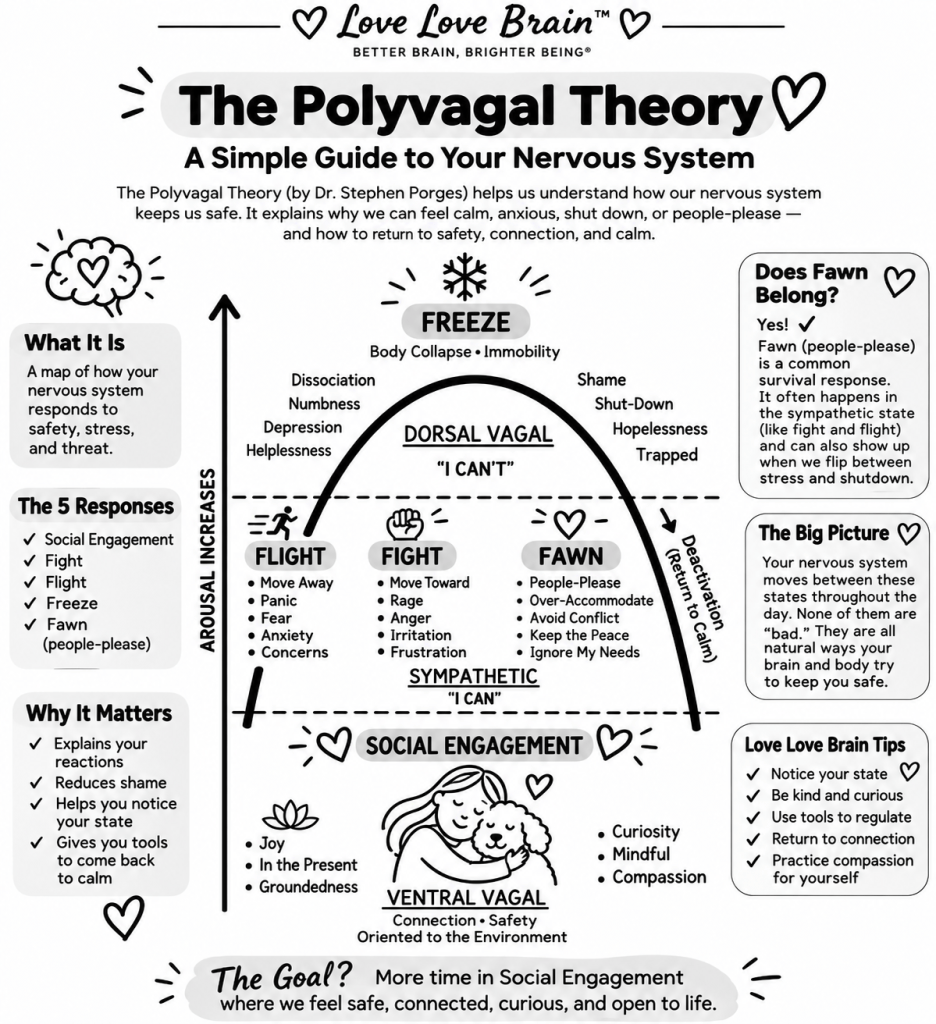
A simple visual showing Fight, Flight, Freeze, Fawn, and Social Engagement, with a short phrase representing each response. Use clear symbols and labels to make the concepts easy to understand.
🧠 What Does This Mean for Brain Injury Survivors?
After a traumatic brain injury, we may struggle with emotional regulation, sensory overload, fatigue, attention, and processing information.
These challenges can make stressful situations especially difficult.
A sudden noise might trigger panic. A correction might provoke anger. Too many decisions might leave us feeling frozen.
And sometimes we may try so hard to avoid conflict that we forget our own needs.
These reactions deserve understanding, not judgment.
However, not every symptom after a brain injury is a trauma response. Freezing, dizziness, difficulty speaking, and dissociation-like experiences can also have neurological or medical causes.
Polyvagal Theory offers one way of understanding our experiences, but its specific explanations of nervous-system states remain scientifically debated. It is not a diagnostic tool.
♥️ Five Gentle Ways to Find Our Way Back
🌬️ Breathe gently. Try a slow, comfortable exhale without forcing your breathing.
🐶 Connect. Spend time with a trusted person or loving pet.
🌿 Ground yourself. Notice your feet on the floor and the objects around you.
🚶 Move gently. Walking, stretching, or another comfortable movement may help release tension.
💕 Practice self-compassion. Ask yourself, “What do I need to feel a little safer right now?”
Different strategies work for different people. The goal is not to force ourselves into calmness but to discover what genuinely helps.
🌷 The Love Love Brain Message
We are not our fight response.
We are not our flight response.
We are not our freeze response.
And we are certainly not defined by our fawn response.
These are patterns we can begin to recognize, understand, and respond to with greater compassion.
Healing isn’t about never feeling afraid, angry, or overwhelmed again.
It’s about learning to recognize our needs, honor our boundaries, and find our way back to connection, one loving moment at a time.
📱 Follow and Support Love Love Brain
If this message speaks to you, please support Love Love Brain by following us on social media. 💗
Stay connected for more stories, reflections, helpful information, and supportive content about brain injury, recovery, resilience, and everyday life.
Click the buttons below to follow and support us on social media:
The information shared in this blog is intended for educational and supportive purposes only. Polyvagal Theory offers one perspective on understanding stress and nervous-system responses, but it is not a diagnostic tool. Every brain injury and recovery experience is different. This content is not a substitute for professional medical advice, diagnosis, or treatment. Please consult a qualified healthcare professional about your individual needs.


Do you Love Love YOUR Brain?