
Better Brain, Brighter Being™
A personal journey of brain injury, recovery, hope and learning to live again.
💔 1. Life Before and After Brain Injury
An acquired brain injury (ABI) can completely change your life.
I was 50 years old when I sustained my brain injury. Before my accident, I didn’t struggle with depression, anxiety or impulsivity, and I wasn’t taking prescription medications.
Suddenly, everything changed.
Today, recovery is my full-time job. I spend hours attending cognitive rehabilitation, speech therapy, mental health treatment and peer support programs.
❤️ Brain injury doesn’t just change your brain. It changes how you experience your entire life.
You must learn how to live again.
📖 2. Why I Created Love Love Brain
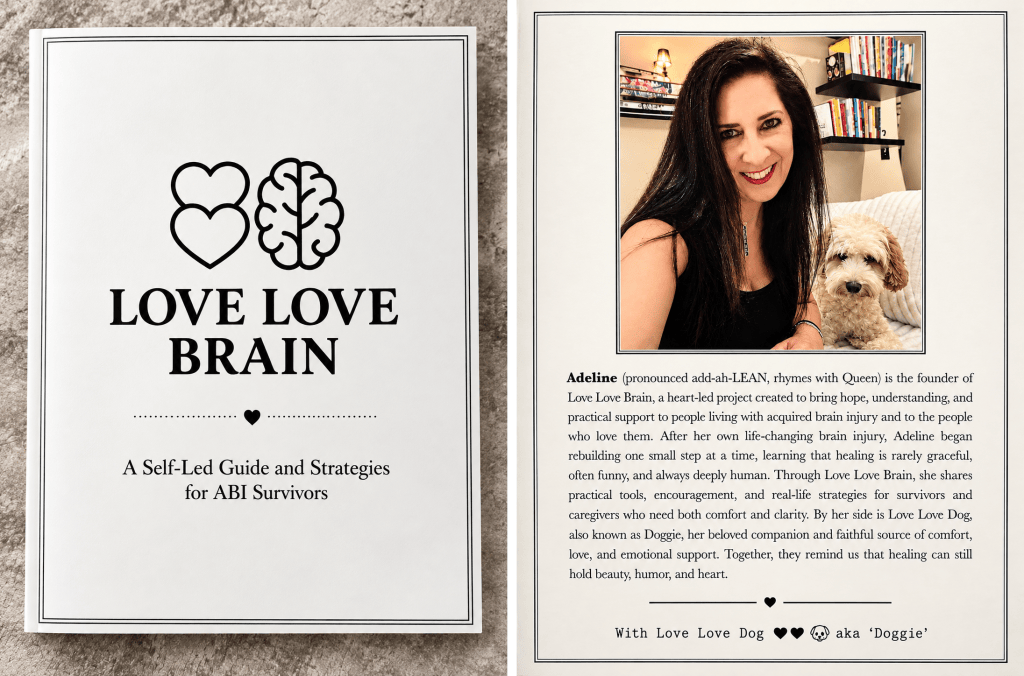
I created Love Love Brain with the assistance of ChatGPT because I wanted something practical, simple and accessible for brain injury survivors.
It’s more than a book. It’s an interactive, self-led workbook designed to help people understand and manage their symptoms.
🧠 How the workbook works
🔍 Identify the symptom you’re experiencing.
📖 Find that symptom in the table of contents.
❤️ Read the Love Love Note for understanding and reassurance.
🛠️ Explore seven practical strategies, called Love Supports.
✍️ Write your own personalized strategies in the space provided.
The workbook can be completed independently or with help from a caregiver, friend or therapist.
🌈 3. Example: Managing Sensory Overload
During my presentation, I was experiencing sensory overload from the lighting, background noise and Zoom environment.
I demonstrated how the workbook addresses this exact experience.
❤️ Love Love Note:
“Your brain is taking in too much at once. This is not a weakness; it’s biology.”
🛠️ Practical Love Supports
🔇 Reduce background noise.
💡 Dim the lights.
😌 Close your eyes and rest.
🌬️ Practice slow, gentle breathing.
🎶 Listen to calming music or waterfall sounds.
📱 Take a break from your phone and other stimulation
🛡️ Protect your nervous system by stepping away from overwhelming situations.
Everyone experiences brain injury differently. What works for me might not work for you.
That’s why personalizing your recovery strategies is so important.
⭐ 4. My Most Important Advice: Prepare While You’re Feeling Well
Don’t wait until you’re overwhelmed to develop your recovery strategies.
This is one of the most valuable lessons I’ve learned from therapy.
☀️ When you’re feeling well:
🔍 Explore your symptoms.
🧪 Experiment with different strategies.
💡 Identify what works for you.
📝 Write down your personal solutions.
🌧️ When you’re struggling:
📖 Open your workbook.
🔍 Find the symptom you’re experiencing.
📝 Read your own personalized notes.
🌿 Follow the strategies you prepared when you were feeling better.
Your workbook becomes a personalized recovery resource that you can turn to when you need it most.
🗣️ 5. My Personal Recovery Journey
Following my injury, I experienced severe communication difficulties.
I couldn’t communicate properly in any of my three languages: English, Farsi or French.
As my aphasia began improving, I struggled with stuttering, slurred speech and the frustration of being unable to express myself.
Today, I’m able to share my experiences and help other survivors.
🌱 Recovery takes time, patience, support and a willingness to keep learning.
🤝 6. You Don’t Have to Recover Alone
There are many resources available to support brain injury recovery.
🧠 Cognitive rehabilitation and speech therapy
❤️ Mental health professionals
🤝 Peer-led support groups
📚 Educational books and workbooks
💊 Appropriate medication when recommended by your doctor
🤖 AI tools to help with communication, organization and learning
AI is not a replacement for medical professionals, but it can be a valuable additional resource.
💖 7. My Message to Every Brain Injury Survivor
Recovery is not an easy road.
You may grieve the person you once were while learning to understand the person you are today.
But there is hope.
You can discover new strategies, find supportive people, develop new skills and build a meaningful life.
You don’t have to do everything alone, and you don’t have to figure everything out at once.
❤️ My hope is that Love Love Brain helps survivors and their loved ones feel understood, supported and empowered to participate in their own recovery.
❤️ Better Brain, Brighter Being™
There is hope with help.
❤️❤️🧠
🛒 Get the Book on Amazon
If you would like to explore the book yourself:
Love Love Brain may earn a small commission from qualifying purchases made through this link. This does not affect the price you pay.
🎥 Watch the Video
Watch the video that inspired this blog post:
📱 Follow and Support Love Love Brain
If this message speaks to you, please support Love Love Brain by following us on social media. 💗
Stay connected for more stories, reflections, helpful information, and supportive content about brain injury, recovery, resilience, and everyday life.
Click the buttons below to follow and support us on social media:
Note: Every brain injury is different. This content is for education and support, not medical advice.


Do you Love Love YOUR Brain?