
A traumatic brain injury (TBI) can change many parts of a person’s life. Survivors may notice differences in their emotions, reactions, confidence, relationships, and even the activities they enjoy.
Sometimes, these changes are misunderstood by the people around them. A survivor may react emotionally, struggle to control an impulse, become overwhelmed by a situation, or find comfort in activities that others consider childish.
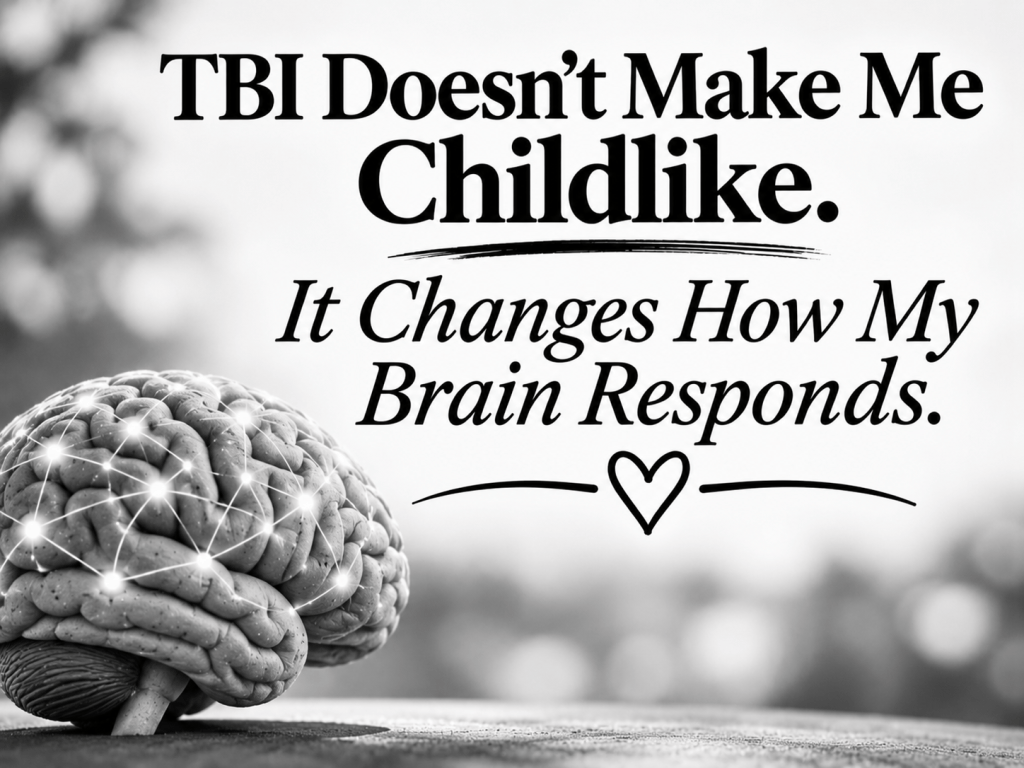
But having a brain injury does not mean someone has become a child.
A person can experience changes in how their brain responds without losing their intelligence, maturity, identity, or adulthood.
Understanding this distinction can help survivors feel less judged and help family members, friends, and caregivers respond with greater patience and compassion.
🧠 When Your Emotional Responses Change
After a brain injury, some survivors experience changes in emotional regulation and impulse control.
You might react before you have time to think through what is happening. You may become frustrated, angry, anxious, or upset more quickly than you did before your injury.
Sometimes, you may not understand why you reacted that way until you have had time to calm down.
This can be confusing and frustrating. You might look back at a situation and wonder why you responded so strongly.
These experiences do not automatically mean you are immature or behaving like a child. A brain injury can affect how the brain processes information and regulates responses.
Recognizing that your reactions may have changed is an important step toward finding strategies that help you manage difficult moments.
💭 Understanding Your Reactions After They Happen
One challenging part of living with a brain injury can be recognizing what happened only after the emotional intensity has passed.
In the moment, a reaction may feel immediate and difficult to control. Later, when you have had time to rest and process the situation, you may understand what triggered it.
That does not make your feelings any less real.
It may help to give yourself time before responding to difficult conversations, decisions, or situations. Taking a break, finding a quieter environment, or explaining that you need a moment can create space for your brain to process what is happening.
Family members and caregivers can help by allowing survivors time to respond instead of expecting an immediate explanation.
🦋 Feeling Disconnected From the Person You Used to Be
A brain injury can affect how you experience yourself and the world around you.
You may notice that your confidence has changed, your interests are different, or activities that once felt easy now require more effort.
You might miss the person you were before your injury. You may also feel uncertain about who you are becoming.
This can bring grief, frustration, and questions about identity.
It is important to remember that your identity is not defined only by what you could do before your injury.
You are still an adult with experiences, preferences, relationships, opinions, and personal worth. Your abilities or responses may have changed, but that does not erase who you are.
🎨 Finding Comfort in Simple and Creative Activities
Some survivors discover that activities such as coloring, building with LEGO, crocheting, or other creative projects bring them comfort.
These activities may offer a manageable way to focus attention, express creativity, or enjoy a quiet moment.
However, enjoying something simple or playful does not make an adult childlike.
Adults can enjoy coloring books, puzzles, toys, crafts, games, and creative hobbies. There is no age limit on finding something that brings you peace.
What matters is whether an activity is meaningful, enjoyable, or helpful to you.
Rather than judging a survivor’s interests, we can recognize that different people find comfort and enjoyment in different ways.
💕 Changes in Intimacy and Relationships
Brain injury can also affect relationships and how survivors experience intimacy.
You may notice changes in your emotional needs, confidence, communication, or comfort with physical and emotional closeness.
These changes can be difficult for both survivors and their partners. A partner may not understand why something that once felt natural now feels different. A survivor may struggle to explain feelings or needs that have changed.
Open communication, patience, and mutual respect are important.
It is also important to remember that survivors have the right to personal boundaries. They should not feel pressured to behave as they did before their injury or to meet someone else’s expectations of what recovery should look like.
Relationships may need to adapt as both people learn to understand the changes.
❤️ We Need Understanding, Not Judgment
When someone experiences a brain injury, the people around them may notice changes in behavior without understanding what could be happening beneath the surface.
A strong emotional response might be labeled as overreacting. A need for rest might be mistaken for laziness. Enjoying a creative activity might be viewed as childish.
These assumptions can make an already difficult experience even more painful.
Instead of judging, we can ask what support would help.
For survivors:
🌱 Give yourself permission to acknowledge that some things feel different.
💭 Notice situations that lead to frustration, overwhelm, or strong emotional reactions.
☕ Take breaks when you need them.
🌼 Explore activities that bring you comfort and enjoyment.
💬 Communicate your needs and boundaries when you can.
💗 Remember that needing support does not make you less capable or less worthy.
For family members, friends, and caregivers:
🤝 Speak to survivors as adults and treat them with dignity.
⏳ Allow extra time for processing and responding.
💗 Avoid mocking or criticizing emotional reactions.
🌱 Do not assume that a person’s interests or abilities define their maturity.
🙋 Ask before offering help, and respect personal boundaries.
🌻 Recognize progress without expecting recovery to follow a straight line.
Compassion does not mean ignoring difficult behavior or removing every boundary. It means responding with respect while recognizing that a person may be navigating changes they did not choose.
🌱 Healing Is Also About Discovering Who You Can Become
A traumatic brain injury can change how someone responds to emotions, relationships, everyday activities, and the world around them.
But those changes do not automatically take away their intelligence, maturity, or identity.
We are still adults. We still deserve to make decisions, express our feelings, enjoy our interests, establish boundaries, and participate in relationships with dignity.
Healing does not always mean returning to exactly who we were before.
Sometimes, it means understanding our new challenges, discovering different ways to support ourselves, and finding meaningful ways to move forward.
💗 Love Love Brain Thoughts
At Love Love Brain, we believe that people living with brain injuries deserve understanding, patience, and respect.
A brain injury may change how someone responds, but it does not make that person less of an adult or less deserving of love.
We should not measure someone’s maturity by how quickly they process information, how well they manage emotions, or whether their interests match what society considers appropriate for their age.
Instead, we can make room for different experiences and recognize the person beyond the injury.
We don’t need judgment. We need understanding, patience, boundaries, and practical tools.
You are still worthy of love, respect, and dignity, exactly as you are.
💬 We’d Love to Hear From You
Have you experienced changes in your emotions, interests, confidence, or relationships after a brain injury?
Have you ever felt misunderstood because someone judged your reactions or the activities you enjoy?
If you are a caregiver, family member, or friend, what have you learned about supporting someone whose responses have changed after a brain injury?
Share your thoughts in the comments. Your experience may help another survivor or caregiver feel less alone. 💗
📱 Follow and Support Love Love Brain
If this message speaks to you, please support Love Love Brain by following us on social media. 💗
Stay connected for more stories, reflections, helpful information, and supportive content about brain injury, recovery, resilience, and everyday life.
Click the buttons below to follow and support us on social media:
Note: Every brain injury is different. This content is for education and support, not medical advice. Changes in emotional regulation, behavior, or relationships should be discussed with an appropriate healthcare professional when they cause concern.


Do you Love Love YOUR Brain?