
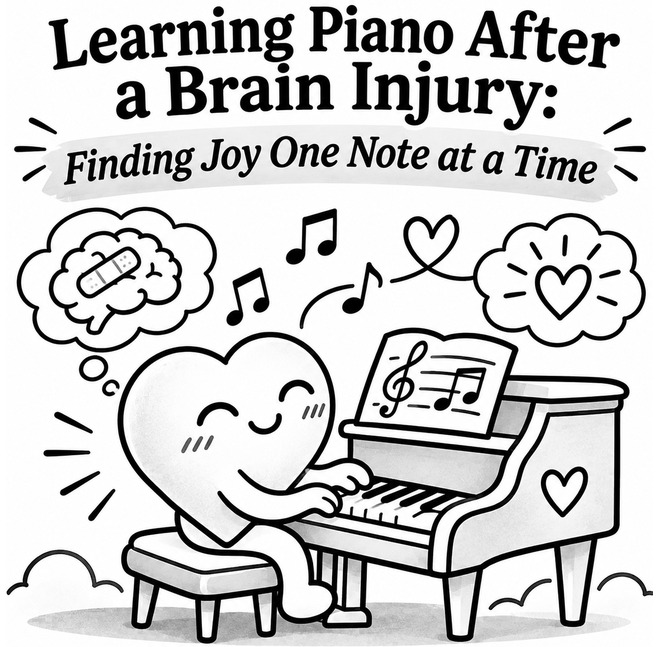
Who knew a tiny toy keyboard could become part of my brain injury journey? 💕
I’m learning to play “Hard to Say I’m Sorry” by Chicago, a song I’ve always loved.
I’m not trying to become a professional pianist. I want to challenge my brain, build my confidence, practice new skills, and most importantly, find HAPPINESS! ❤️
🧠 Why I’m Learning Piano After TBI
Recovery isn’t just about medical appointments and therapy.
It’s also about finding activities that challenge us and bring us joy.
Learning piano gives me a chance to practice several skills at once.
🤲 1. Fine Motor Skills and Coordination
Playing piano requires controlled finger movements and hand coordination.
After a brain injury, even simple movements can sometimes be challenging.
🎹 Playing piano gives my fingers a fun workout!
🧠 2. Memory and Learning
Here’s the funny part: Sometimes I forget the song I’m learning! 😂
My teacher patiently plays the notes slowly, but I sometimes find it harder to remember the melody that way.
I’m discovering that connecting the notes to a familiar song helps me remember them.
Learning music also gives me a chance to practice memory, attention, movement, and listening.
The brain’s ability to adapt and change through learning is called neuroplasticity.
Playing piano is not a guaranteed TBI treatment, but it is a meaningful activity that lets me practice new skills.
🎯 3. Focus and Concentration
Learning a melody requires me to:
🎵 Listen carefully.
👀 Find the correct keys.
🤲 Coordinate my fingers.
🧠 Remember what comes next.
🔁 Repeat the notes.
That’s a lot of brain activity for one little song!
💪 4. Patience and Confidence
Before my injury, I was used to learning quickly and accomplishing difficult things.
Now, remembering a few piano notes can feel like a big achievement.
I’m learning something important:
Progress doesn’t have to be big to be meaningful.
Every time I remember another note, I celebrate a little victory.
😊 5. Happiness and Emotional Well-Being
This might be my favorite part!
Music can bring back memories, lift our mood, and help us express our feelings.
Living with TBI can bring anxiety, frustration, and emotional exhaustion.
Having something enjoyable to look forward to means so much.
Sometimes, the best reason to learn something new is simply because it makes us HAPPY! 💕
🎹 My Simple Piano Learning Strategy
I’ve discovered that traditional learning methods don’t always work for my injured brain.
So I’m finding ways that work better for me!
🎧 LISTEN: Hear the familiar song first.
🎤 SING: Hum the melody before touching the keyboard.
🎹 PLAY: Practice a few notes at a time.
🗣️ SAY: Speak the note names aloud.
🔁 REPEAT: Practice in short sessions.
🙈 REMEMBER: Try playing without looking at my notes.
❤️ CELEBRATE: Appreciate every little improvement!
I’ve also noticed that playing a familiar melody very slowly can make it harder for me to recognize.
Connecting the notes to a song I already love helps me learn.
🌸 Remember to Rest and Avoid Brain Fatigue
One of the biggest challenges after a TBI is having limited mental energy.
Something that looks simple to another person can require a lot of concentration.
That’s why I keep my practice sessions short.
Five minutes of enjoyable practice can be better for me than pushing myself until I’m exhausted.
And if I forget everything tomorrow?
I’ll simply begin again. ❤️
💕 My Biggest Lesson: Recovery Can Include FUN!
Brain injury recovery can involve many appointments, treatments, exercises, and responsibilities.
But I don’t want my life to revolve only around what I’ve lost.
I want to discover what I can still learn, enjoy, and become.
Maybe I’ll eventually play the entire song beautifully.
Maybe I’ll only master the opening melody.
Either way, I’m giving myself a chance to learn something new while giving my heart something to smile about.
Healing isn’t always about getting back to who we were. Sometimes, it’s about finding new ways to experience joy. 🌷
❤️ A Little Challenge for Fellow Brain Injury Survivors
Is there something you’ve always wanted to learn?
🎨 Painting
🎹 Playing music
🧶 Knitting
🌱 Gardening
💃 Dancing
Choose something that makes you happy. Adapt it to your abilities and start small.
You don’t have to be good at it.
You just have to enjoy the journey.
One note. One memory. One little victory at a time. 🎹🧠💕
🎥 Watch Adeline’s Video
Watch Adeline as she learns to play the piano and shares how music has become a fun part of her life after brain injury.
💬 We’d Love to Hear From You
What is something you’ve always wanted to learn or try after your brain injury?
Have you found a hobby that brings you happiness?
Share your experience in the comments. Your story might inspire someone else to try something new!
📱 Follow and Support Love Love Brain
If this message speaks to you, please support Love Love Brain by following us on social media. 💗
Stay connected for more stories, reflections, helpful information, and supportive content about brain injury, recovery, resilience, and everyday life.
Click the buttons below to follow and support us on social media:
Note: This article shares Adeline’s personal experiences. Every brain injury is different. Learning piano is a personal activity, not a guaranteed treatment for TBI. This content is for education and support, not medical advice.


Do you Love Love YOUR Brain?