
Our minds are constantly receiving information.
A conversation.
A memory.
A message.
A social interaction.
Something we see online.
Something someone says about us.
Over time, certain thoughts can become familiar patterns.
And sometimes we don’t even realize how often we’re repeating them.
After a brain injury, this can become especially important to notice. Recovery can bring frustration, uncertainty, changes in confidence, and emotions that may feel difficult to manage.
Learning to recognize your thought patterns can be a powerful part of understanding yourself.
💭 What Are You Focusing On?
Think about the thoughts that appear most often.
Are they:
“I’m not good enough.”
“I’ll never get better.”
“Everyone else is moving forward.”
“I should be able to do more.”
“Nobody understands me.”
These thoughts can feel convincing when they repeat often.
But a thought isn’t automatically a fact.
Sometimes we need to pause and question what our minds are telling us.
🧠 Thoughts Can Become Patterns
One negative thought may not seem significant.
But when the same thought appears repeatedly, it can become familiar.
For example:
Something goes wrong → “I can’t do anything right.”
Then another difficult moment happens.
“See? I knew I couldn’t do it.”
The brain begins looking for evidence that supports the existing belief.
This can create a cycle that becomes difficult to notice.
👀 Pay Attention to What You Consume
Our thought patterns aren’t influenced only by what happens inside our minds.
They’re also influenced by what we repeatedly expose ourselves to.
Consider:
📱 Social media
📰 News
💬 Conversations
👥 Relationships
🎬 Entertainment
🧠 The way we talk to ourselves
If everything around you is constantly creating stress, comparison, fear, or negativity, it may affect how you feel and think.
This doesn’t mean avoiding everything difficult.
It means becoming more intentional about what you allow to occupy your mental space.
❤️ Stop Chasing Constant Approval
Sometimes we spend too much energy trying to get approval from other people.
We may wonder:
“Do they like me?”
“What do they think about me?”
“Am I doing enough?”
“Why aren’t I where they are?”
But constantly seeking approval can leave you disconnected from what you actually need.
Your recovery doesn’t have to impress anyone.
Your progress doesn’t have to look impressive to someone else.
It only needs to be meaningful to you.
🌱 Follow What Supports You
Instead of constantly asking:
“What will make everyone else happy?”
try asking:
“What supports my wellbeing?”
Maybe that’s:
⏸️ Taking a break
🌿 Spending time somewhere peaceful
🤝 Talking to someone you trust
📵 Stepping away from social media
🧠 Challenging a negative thought
❤️ Giving yourself permission to have a difficult day
Small choices can influence the direction of your day.
🔄 You Can Challenge an Unhelpful Thought
When you notice a negative thought, try asking:
Is this completely true?
What evidence do I have?
Would I say this to someone I love?
Is there another way to look at this situation?
For example:
Instead of:
❌ “I’m failing at recovery.”
Try:
🌱 “Recovery is difficult today, but I’m still learning.”
Instead of:
❌ “I can’t do anything anymore.”
Try:
🌱 “Some things are harder now, but I can find new ways to do them.”
The goal isn’t to pretend everything is positive.
It’s to make room for a more balanced perspective.
🧠 Your Brain Injury Does Not Define Your Thoughts
TBI can affect emotions, attention, memory, and the way we process information.
That can make difficult thoughts feel even more overwhelming.
If you’re struggling with persistent negative thoughts, emotional distress, or changes that are interfering with daily life, reaching out to a qualified healthcare professional can be an important step.
You don’t have to figure everything out alone.
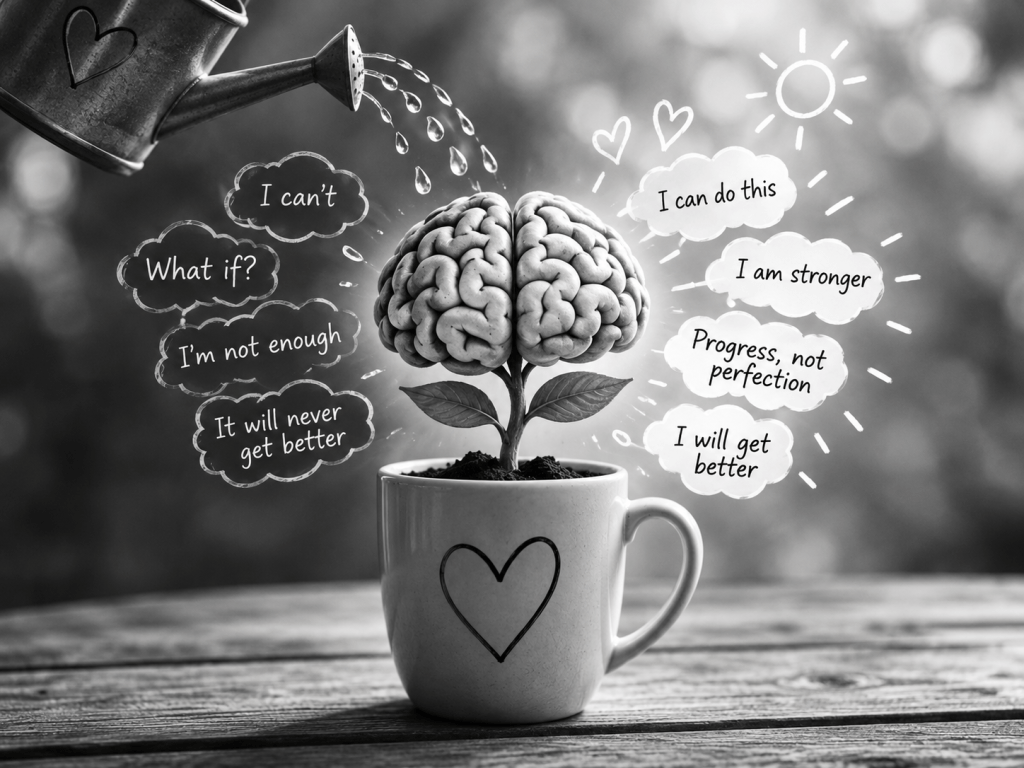
🌻 Choose What You Feed
Imagine your mind as a garden.
🌱 What you repeatedly water can grow.
If you constantly feed fear, comparison, and self-criticism, those patterns may become stronger.
If you feed:
💜 Self-compassion
🌱 Patience
🧠 Awareness
❤️ Hope
🤝 Connection
those qualities can become part of your mental environment too.
You don’t control every thought that appears.
But you can become more intentional about which thoughts you continue to nurture.
✨ Final Thoughts
Your thoughts matter.
Not because every thought is true, but because repeated thoughts can influence how you see yourself and your recovery.
After TBI, you may experience difficult emotions and thought patterns that you didn’t have before.
Be patient with yourself.
Notice what you’re thinking.
Question what isn’t helpful.
And give yourself permission to choose a different perspective.
🧠 Notice the thought.
💭 Question the pattern.
🌱 Choose what supports you.
❤️ Keep growing.
You don’t have to change every thought today.
Sometimes awareness is the first step toward change.


Do you Love Love YOUR Brain?